How to Start Mahila Gruh Udyog: A Complete, Practical Guide
 AuthorMehul Jagwani
 Reviewed ByMadhav Bhayani



Summary:
Mahila Gruh Udyog refers to small-scale, home-based businesses run by women from their own homes, typically focused on manufacturing or processing goods for local or broader markets. Starting a Mahila Gruh Udyog requires choosing the right product, completing basic registrations like Udyam and FSSAI, accessing government loans such as the Mudra Yojana, and managing business finances carefully.
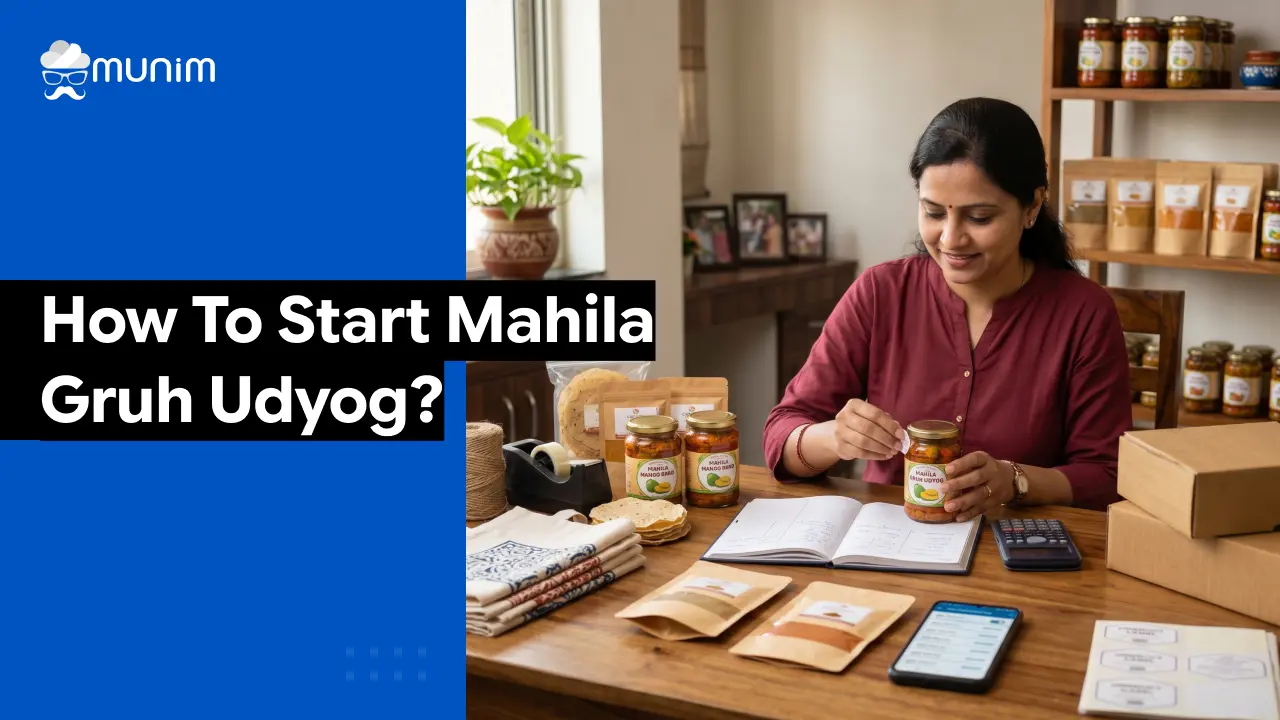
Thousands of women across India are turning their home spaces into thriving small businesses every year. Mahila Gruh Udyog, which literally translates to women’s home industry, is at the centre of this quiet but steady movement. It offers women a practical path to financial independence without needing a large capital investment or a separate commercial space.
This guide covers exactly how to start a mahila gruh udyog from scratch, what products sell well, how to register the business legally, which government schemes apply, and how to manage the financial side of things responsibly.
MSME registration benefits for small businesses. Read Now!
How to Start a Mahila Gruh Udyog: Step by Step
Step 1: Choose the Right Business Idea
The first step in building a successful Mahila Gruh Udyog is choosing the right product.” Ideally, it should be something the entrepreneur is already skilled at making and that people are willing to buy. Many new entrepreneurs make the mistake of following trends without considering whether they have the necessary expertise, resources, or supply chain support to sustain the business. Focusing on a product that matches both your strengths and market demand can significantly improve your chances of success.
Some high-demand categories that consistently perform well include the following.
Food products such as homemade snacks, pickles, papads, masala powders, bakery items, and traditional sweets..
Handloom and textiles including hand-woven sarees, embroidered garments, blouses, and fabric-based home decor.
Herbal and personal care products such as natural soaps, hair oils, face packs, and body scrubs.
Handmade craft and decor including pottery, handmade jewellery, candles, and incense sticks.
Tailoring and garment work such as custom stitching, school uniforms, and embroidery work.
Eco-friendly products like jute bags, cloth tote bags, and handmade paper stationery.
Best profitable small business ideas in India. Know More!
Step 2: Conduct Basic Market Research
Before investing money in raw materials or equipment, it is important to validate that there is actual demand for the product.
Market research for a Mahila Gruh Udyog does not have to be complicated or expensive.” In the beginning, simple steps such as talking to 10–15 potential customers, visiting local markets, and checking product demand on online marketplaces like IndiaMART and Amazon can provide valuable insights. This basic research is often enough to understand customer preferences and identify business opportunities before making larger investments.
Key questions to answer at this stage include: Who is the target customer? What are existing sellers charging? Is there a local gap in supply? Can the product be differentiated on quality, packaging, or price?
Step 3: Prepare a Simple Business Plan
A business plan does not have to be a formal document. For a home-based business, a simple one-page outline covering the product, estimated monthly production capacity, raw material costs, expected pricing, and projected monthly revenue is enough to start.
This plan serves two purposes. It keeps the entrepreneur focused and provides a reference document when approaching banks or government scheme offices for funding.
Simplify Your Business Operations
Designed to give you speed, control, and accuracy in daily accounting tasks.
 Save time with automated accounting workflows
- Get 35+ detailed business reports easily
- Access your business anytime, anywhere
 Save time with automated accounting workflows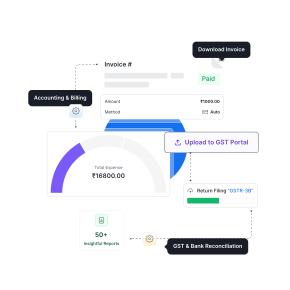
Step 4: Arrange Initial Funding
The initial investment for most mahila gruh udyog businesses is relatively modest. A food-based unit can be started with Rs. 10,000 to Rs. 50,000 in many cases. A handloom or craft-based unit may require slightly more depending on equipment and raw material inventory.
Sources of funding include personal savings, family contributions, and several government-backed loan programs specifically designed for women entrepreneurs; such as:
- Pradhan Mantri Mudra Yojana (PMMY)
- Stand-Up India Scheme
- PMEGP (Prime Minister’s Employment Generation Programme)
- Mahila Udyam Nidhi Scheme
- Annapurna Scheme
If you are looking for business subsidy loan schemes in India! Try it right now!
Step 5: Register the Mahila Gruh Udyog
Registration formalises the business and unlocks access to government subsidies, bank loans, and in some cases, government procurement tenders. The key registrations relevant to a mahila gruh udyog are listed below.
- Udyam Registration (MSME Portal)
- FSSAI Registration (for Food Businesses)
- GST Registration
- Trade License
- Shop and Establishment Act Registration
Step 6: Set Up Infrastructure and Packaging
Most mahila gruh udyog units operate out of a dedicated room or section within the home. The production area should meet basic hygiene standards, especially for food-based businesses.
Packaging plays a crucial role in product perception, particularly when selling online or to retail stores. Even a basic label with the product name, ingredients, manufacturing date, and the FSSAI license number significantly improves buyer trust. Many small producers overlook packaging at the start, only to find that it is one of the biggest factors in converting a first-time buyer into a repeat customer.
Step 7: Market and Sell the Products
Marketing a mahila gruh udyog does not require a large advertising budget. Several low-cost channels work well for home-based women enterprises.
WhatsApp Business is particularly effective for local marketing. A product catalogue, regular updates, and a broadcast list of interested customers can generate consistent orders without any cost.
Social media platforms like Instagram and Facebook are effective for visual products such as handicrafts, food items, and personal care products. Regular posts with good photographs and brief descriptions build brand familiarity over time.
E-commerce platforms like Amazon, Flipkart, Meesho, and IndiaMART allow home-based sellers to reach a national audience. Each platform has its own seller registration and product listing process.
Local exhibitions and bazaars organized by government agencies, NGOs, and community groups provide an opportunity to sell directly to consumers, gather feedback, and build local brand recognition. The KVIC and various state government bodies regularly organize such events for women entrepreneurs.
Local retail partnerships with nearby grocery stores, boutiques, or medical shops can create a steady offline supply channel for products that are purchased regularly.
Conclusion
Starting a mahila gruh udyog in India has never been more accessible. The combination of government loan support, MSME registration benefits, digital selling platforms, and a growing domestic market for artisanal and homemade products creates a genuinely workable environment for women entrepreneurs.
The key is to begin with a clear product idea, complete the necessary registrations early, access funding wisely, and maintain clean financial records from the start. Small businesses that stay organised and compliant have a much better chance of growing steadily and accessing institutional credit when they need to expand.
Frequently Asked Questions
What documents are required to start a Mahila Gruh Udyog?
The basic documents required include the Aadhaar card and PAN of the proprietor, a bank account in the owner’s name or in the business name, address proof for the place of business, and passport-size photographs. Additional documents may be required depending on the specific registration or loan scheme being applied for.
Does a Mahila Gruh Udyog need GST registration?
GST registration is mandatory only when annual turnover exceeds Rs. 40 lakh for goods-based businesses or Rs. 20 lakh for service-based businesses. Most home-based units operating below these thresholds do not need to register compulsorily. However, voluntary registration can help businesses claim input tax credit and operate more formally on e-commerce platforms.
What is the difference between Mahila Gruh Udyog and a regular MSME?
Mahila Gruh Udyog specifically refers to home-based businesses run by women. A regular MSME can be run from a commercial premises, by a person of any gender, and can be larger in scale. However, a mahila gruh udyog registered under Udyam is technically a type of MSME and can access all MSME government schemes.
Is Mahila Gruh Udyog income taxable?
Yes. Income generated from a mahila gruh udyog is taxable as business income under the Income Tax Act.
Disclaimer: "This blog post is for informational purposes only. For specific tax advice related to your business, please consult a qualified Chartered Accountant or GST practitioner."
About the author

Mehul is a seasoned content writer with a passion for simplifying complex accounting and GST topics. With a keen interest in entrepreneurship and business management, he specializes in creating informative and engaging content for themunim.com. His goal is to help businesses understand and implement accounting and GST software solutions effectively. When he's not crafting content, Mehul enjoys exploring new places and spending time with his Golden Retriever.
Related Articles
Explore the latest market news, useful resources for business, and Munim updates.