




Summary:
A sales order is a simple document that confirms exactly what buyers want. Skipping this crucial step often leads to painful billing disputes and lost money. This helpful guide explains exactly how the sales order process works for beginners. We will also show you the mandatory fields needed for everyday business compliance. You can use the Munim app to create sales orders for free right away. We have also answered the most common questions about writing perfect sales orders.
A wholesale trader dispatches 800 units on a WhatsApp confirmation. Two weeks later, the buyer disputes the rate. Sound familiar? Many Indian SMEs still confirm orders over the phone or chat, then face denied quantities, prices, and delivery timelines.
For manufacturers and distributors running billing and accounting software, a sales order separates clean dispatch from costly disputes. This guide explains the basics, walks through processing, and hands you a ready template.
What Is Sales Order, Really?
Not understanding “What is sales order?” costs Indian businesses real money. So let’s be precise. A sales order is a document that the seller issues to confirm a buyer’s purchase. It records products, quantities, prices, delivery terms, and payment conditions.
Think of it as your internal commitment to deliver. It usually follows a purchase order from the buyer. Once you add transaction terms and obligations, it often becomes a legally binding document.
For a manufacturer, this single record drives production planning, stock reservation, and dispatch. Nothing moves until the order is confirmed on paper.
Sales Order vs Quotation vs Invoice
These three documents are easy to confuse. A quotation is only an offer. At its core, a sales order is the confirmation of that offer. The invoice comes last and requests payment.
Here is the simple flow:
- Quotation: You propose price and terms.
- Sales order: The buyer accepts, you commit.
- Invoice: Goods shipped, payment is due.
A note on GST: A sales order often displays the tax breakup for clarity, but it does not generally create a tax liability.
Document Flow Tip: In a standard supply chain, the flow looks like this:
PO -> Sales Order -> Delivery Challan / E-way Bill -> Invoice.
What Is Sales Order Processing?
It is the journey from order receipt to fulfillment. While complex enterprises have dozens of steps, for most MSMEs, it is a high-level, four-stage lifecycle:
- Order creation & validation: Details are entered into your billing software or spreadsheet. Customer GSTINs are verified, and basic credit checks are run.
- Order processing: Your team confirms stock availability, lead times, and payment terms.
- Fulfilment: Goods are picked, packed, and shipped out alongside a Delivery Challan and E-way bill (if applicable).
- Invoicing & Archiving: The final invoice is raised against the sales order, and the record is stored for audits.
A disciplined process prevents the classic SME mistake: raising an invoice with no underlying order. That gap is exactly where disputes over wrong SKUs, missing quantities, or mismatched delivery dates begin.
What Is a Sales Order Form, and What Goes In It?
What is a sales order form without the right fields? Just a piece of paper. The form is the template that captures every detail consistently. For Indian MSMEs, specific GST compliance fields are non-negotiable.
Ensure your form includes:
- Order number and date: Avoid duplicate numbers; prefer sequential automated numbering. Manual numbering is fine if strictly controlled.
- Seller and Customer details: Full registered names, billing addresses, shipping addresses, and valid GSTINs.
- Item details: Clear product names, exact SKUs, and mandatory HSN/SAC codes.
- Quantity and rate: The approved figures.
- Place of Supply: Critical for determining whether to charge IGST or CGST/SGST.
- Delivery and Payment terms: Expected dispatch dates, and terms (e.g., Advance, Net-30).
- Approval: Confirms the order is locked. E-signatures or formal email approvals are widely accepted and provide a solid audit trail.
Knowing what a sales order form should contain protects both sides. Vague descriptions get the wrong goods shipped. Missing payment terms delays your collections.
Simplify Your Business Operations
Designed to give you speed, control, and accuracy in daily accounting tasks.
 Save time with automated accounting workflows
- Get 35+ detailed business reports easily
- Access your business anytime, anywhere
 Save time with automated accounting workflows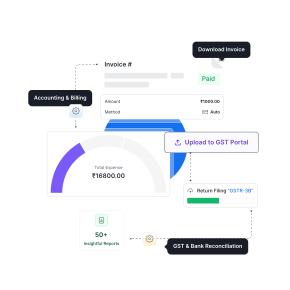
A Real Scenario: The Bulk Distribution Order
Picture a mid-sized garment manufacturer in India. A corporate gifting client orders 1,000 polo shirts at ₹420 each. Total order value: ₹4,20,000.
Without a sales order, the rep notes it on WhatsApp. Production starts. Later, the client claims the agreed rate was ₹390. The ₹30 gap across 1,000 units is ₹30,000 – gone.
Now run it correctly. A proper sales order form locks ₹420, the exact quantity, and a net-30 term. Stock is safely reserved in your inventory system.
Dispatch matches the order. The invoice references it. No dispute, no lost margin. This is why D2C brands moving into B2B adopt sales orders early. Bulk deals carry bulk risk.
How to Create a Sales Order: Two Paths
Path 1: Manual With a Spreadsheet Template
- Best for: Startups and very low-volume traders.
- Pros/Cons: It is free and easy to set up, but highly prone to human error. You must manually check stock, format GSTINs correctly, and type out HSN codes.
- Trigger to switch: When you start processing more than a dozen B2B orders a week, or if you ever accidentally ship an order with the wrong pricing.
Path 2: Automated With Software
- Best for: Growing MSMEs, manufacturers, and scale-ups.
- Pros/Cons: Requires an upfront software investment, but centralises everything.
- How it works: Modern accounting software converts an approved quotation into a sales order in one click. It automatically reserves inventory, applies the correct GST rates based on the Place of Supply, and gives your logistics team a clean picking list.
Conclusion
A sales order is not paperwork for its own sake. It is the control point that keeps dispatch, billing, and customer trust intact. For Indian MSMEs scaling production or stepping into B2B, the discipline pays for itself in fewer disputes and faster payments.
Start simple. Adopt the template today, standardise your fields, and tighten your fulfilment process. Once your volume grows, move this process into your billing software to lock every deal digitally and securely.
Frequently Asked Questions (FAQs)
Is a sales order legally binding?
Not automatically. A sales order generally becomes enforceable once both parties accept it and the transaction terms are clearly stated. For Indian MSMEs, including signatures, agreed rates, and delivery terms, strengthens its standing if a dispute arises.
What are the 5 C’s of sales?
A widely used version is Credibility, Curiosity, Connection, Customisation, and Closing. Credibility earns trust, curiosity uncovers the real need, connection builds rapport, customisation tailors the offer, and closing secures commitment.
Can I raise an invoice without a sales order?
Yes, but it raises the risk of errors and customer disputes. The sales order locks quantity, rate, and terms before dispatch. Without it, your billing team has nothing to verify against, which is exactly how wrong rates and quantities slip into invoices.
How long should I keep sales orders?
Retain them per statutory requirements. In India, it is commonly recommended to keep GST-related transaction records for 72 months (6 years) from the due date of furnishing the annual return for the year. Additionally, the Companies Act requires books of accounts to be kept for 8 years. Always consult with your chartered accountant for specifics.
Does the sales order show GST?
GST can appear on the document for clarity, but the actual tax liability arises only at the invoice stage. So treat GST on a sales order as informational, not as a tax event. This distinction matters when reconciling your books.
What are the 7 steps of the sales process?
The classic seven steps are: prospecting, preparation, approach, presentation, handling objections, closing, and follow-up.
What is the 70/30 rule in sales?
The 70/30 rule says the prospect should talk about 70% of the time, and the salesperson only 30%. The logic is simple: more listening surfaces the real needs, budget, and objections. Sellers who dominate the conversation often miss the buying signals that lead to a close.
Can a sales order be edited later?
Yes, if both sides agree to the change. Always document revisions through a formally updated order (e.g., “Version 2”) rather than an informal message. If the order has already been partially fulfilled, you may need to issue debit or credit notes.
Disclaimer: "This blog post is for informational purposes only. For specific tax advice related to your business, please consult a qualified Chartered Accountant or GST practitioner."
About the author


Jayant is a senior content writer and digital marketer, known for his extensive experience in commercial SEO writing, blog content, website copy, and B2B communication. Since 2019, he has worked on diverse freelance projects across industries. His portfolio includes articles, landing pages, social media content, and web development collaborations. Blending clarity, creativity, and strategic messaging, he specialises in crafting professional, audience-focused content for themunim.com.
Related Articles
Explore the latest market news, useful resources for business, and Munim updates.