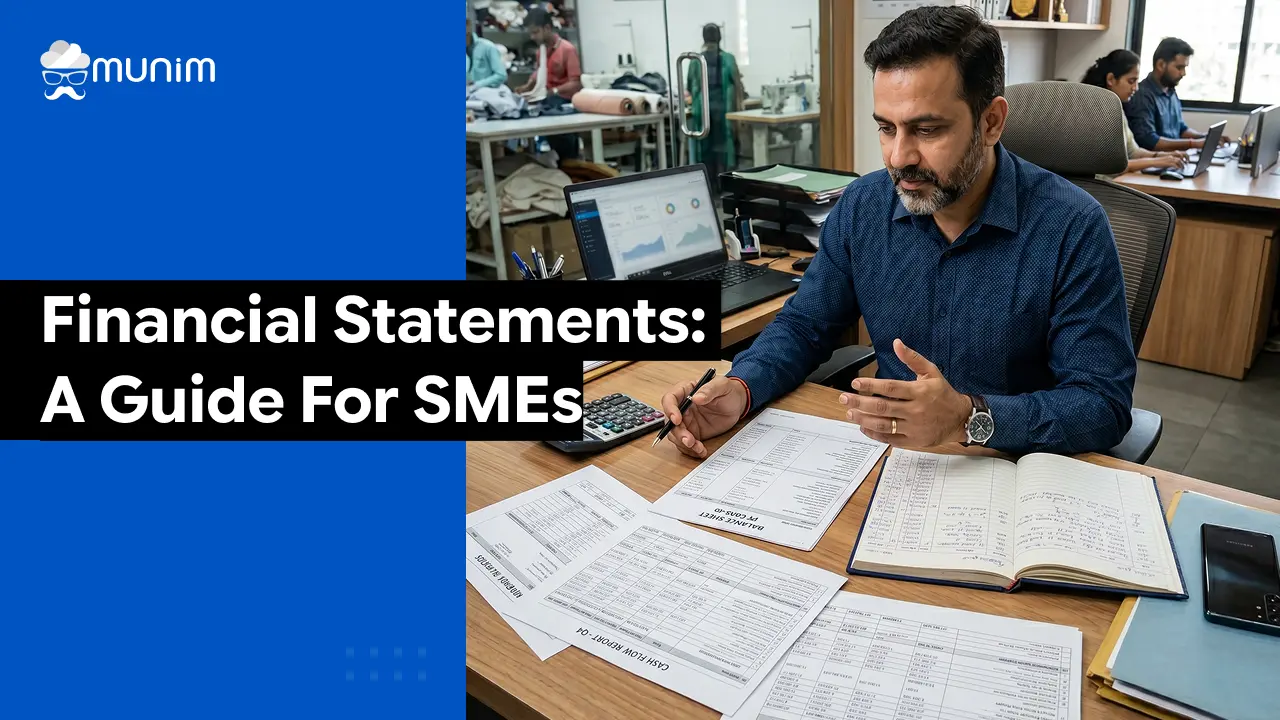
What Are Financial Statements? Types & Importance for SMEs
 AuthorJayant Surana
 Reviewed ByAjay Savani



- Financial Statement Meaning: A simple Definition
- What Are the Objectives of Financial Statements?
- Types of Financial Statements Every SME Must Know
- The Unsung Hero: Notes to Accounts
- Importance of Financial Statements for SME Businesses
- Financial Statement Analysis: Reading the Story Behind the Numbers
- How to Prepare Financial Statements: A 5-Step Process
- Internal Management vs. External Compliance
- Limitations of Financial Statements
- Financial Statements Are a Decision Tool, Not Paperwork
- Frequently Asked Questions (FAQs)
Summary:
Financial statements are the ultimate health check for your business. They turn daily transactions into clear, readable reports. This visibility helps you spot financial leaks before they sink your company.
Mastering these documents is crucial for any growing SME. They are not just compliance paperwork meant for your accountant. They are the keys to unlocking bank loans, investor funding, and sustainable growth.
This guide breaks down everything from the balance sheet to the cash flow statement. You will learn how to read the story behind your numbers in plain English. Start making data-driven decisions today.
Imagine working 14-hour days, watching your sales climb, and still struggling to pay your vendors at the end of the month. It is a terrifying reality for countless small business owners who look highly profitable on paper but are secretly bleeding cash.
The missing link is rarely a lack of hustle; it is a lack of financial visibility. You cannot fix leaks you cannot see. That visibility comes from one place: financial statements. Yet many SME owners treat them as a year-end formality. Something the CA prepares. Something filed and forgotten.
This guide changes that. You will learn the financial statement meaning, the core types of statements. Further, you will understand why these reports decide your loan approvals, investor conversations, and survival.
Financial Statement Meaning: A simple Definition
Financial statements are formal written records. They summarise a business’s financial position, performance, and cash movements for a specific period. The three core financial statements are the balance sheet, the income statement (profit and loss), and the cash flow statement.
The statement’s meaning goes beyond bookkeeping. Your books record individual transactions – every sale, purchase, and payment. The statements condense thousands of those entries into a few structured reports. Anyone can read them in minutes.
In India, this is also a legal requirement. Under Section 129 of the Companies Act, 2013, financial statements must give a “true and fair view” of the company’s affairs and follow the formats prescribed in Schedule III.
One relief exists: small companies, OPCs, and dormant companies may skip the cash flow statement. Most lenders, however, still ask for it.
What Are the Objectives of Financial Statements?
Each report exists to answer specific questions for specific people:
- Show owners whether the business genuinely earned a profit.
- Help lenders judge repayment capacity before sanctioning loans.
- Give investors a reliable basis for valuing the business.
- Support GST and income tax filings with verified figures.
- Enable comparison – this year versus last, you versus competitors.
These reports communicate financial health to stakeholders who never see your daily operations. For an SME owner, the most practical objective is simpler. Know exactly where you stand – before someone else tells you.
Types of Financial Statements Every SME Must Know
There are three core types of financial statements. Larger companies add a statement of changes in equity and notes to accounts. For most SMEs, mastering these three is enough.
1. Balance Sheet: What You Own vs. What You Owe
The balance sheet is a snapshot on a single date. It lists assets (what you own), liabilities (what you owe), and equity (what is truly yours).
The golden equation never changes: Assets = Liabilities + Equity. If your machinery, stock, and receivables total ₹50 lakh, and you owe ₹20 lakh, your equity is ₹30 lakh.
2. Income Statement (P&L): Did You Make Money?
The income statement covers a period – a quarter or a year. It starts with revenue, subtracts every expense, and ends with net profit or loss.
This is the report most owners check first. It answers the simplest question: are we actually profitable?
3. Cash Flow Statement: Where Did the Money Go?
Profit is an opinion; cash is a fact. The cash flow statement tracks real money moving in and out, split across operating, investing, and financing activities.
A business can show healthy profit yet run out of cash. This statement catches that danger early.
Here is how the three compare side by side:
| Statement | Time Frame | Key Question It Answers | Core Components |
| Balance Sheet | One specific date | What is the business worth right now? | Assets, liabilities, equity |
| Income Statement | A period (quarter/year) | Did we earn a profit? | Revenue, expenses, net profit |
| Cash Flow Statement | A period (quarter/year) | Where did cash come from and go? | Operating, investing, financing flows |
The Unsung Hero: Notes to Accounts
The core financial statements get all the attention. However, the Notes to Accounts are equally crucial. These notes act as the vital fine print.
They explain exactly how you calculated your numbers. This includes detailing your accounting policies and depreciation methods. The notes also reveal pending lawsuits or hidden liabilities.
Raw numbers lack context on their own. Bank managers and serious investors read these notes carefully. You should treat them as a mandatory part of your financial reporting.
Importance of Financial Statements for SME Businesses
The importance of financial statements becomes obvious the day you need money. India’s MSME sector contributes roughly 30.1% of GDP and 45.73% of national exports (PIB, Ministry of MSME).
Yet the RBI’s Expert Committee estimated the sector’s credit gap at ₹20-25 trillion in 2023 (PIB). A major reason? Weak or missing financial records. Banks cannot lend against numbers they cannot see.
Here is what clean financial statements unlock for an SME:
- Faster loan approvals: Bankers assess repayment capacity directly from your P&L and balance sheet
- Investor readiness: No serious investor writes a cheque without audited statements
- Smarter pricing and cost control: Spot exactly which expenses are eating your margins
- Tax accuracy: Fewer notices, smoother GST and income tax filings
- Early warning signals: Weakening cash flow shows trouble months before a crisis hits
These compliance wins are only the start. The broader benefits of financial reporting compound over time. Better data drives better decisions.
Better decisions, in turn, produce better numbers. That, in one line, is the importance of financial statements – they convert daily effort into bankable evidence.
Simplify Your Business Operations
Designed to give you speed, control, and accuracy in daily accounting tasks.
 Save time with automated accounting workflows
- Get 35+ detailed business reports easily
- Access your business anytime, anywhere
 Save time with automated accounting workflows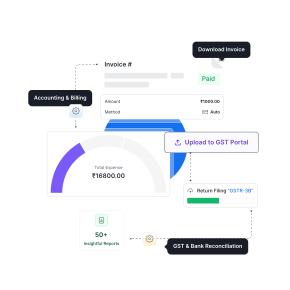
Financial Statement Analysis: Reading the Story Behind the Numbers
Preparing reports is step one. Financial statement analysis is where the real value lies. The three statements interlink – profits flow into equity, and cash movements explain balance sheet changes.
You do not need complex models. A real scenario shows why. Ramesh runs a textile unit in India. His FY 2025-26 numbers:
- Revenue: ₹1.2 crore | Net profit: ₹9.6 lakh
- Current assets: ₹30 lakh | Current liabilities: ₹15 lakh
- Receivables stuck with customers: ₹22 lakh
Now apply basic financial statement analysis:
- Net profit margin = 9.6 ÷ 120 = 8%. Workable for textiles, but thin.
- Current ratio = 30 ÷ 15 = 2.0. A healthy short-term position on paper.
- Receivables concentration = ₹22 lakh of ₹30 lakh current assets = 73%. Red flag.
Ramesh looks profitable and liquid. But 73% of his current assets sit with customers. One large default could trigger a cash crisis within weeks. His income statement would never reveal this risk. His balance sheet and cash flow statement just did. That is the quiet power of analysis.
How to Prepare Financial Statements: A 5-Step Process
Financial reports are built entirely from your underlying books of accounts. Follow this practical sequence:
Step 1: Record every transaction
Sales, purchases, salaries, rent – nothing skipped. Start by learning how to keep track of business expenses systematically.
Step 2: Reconcile bank statements monthly
Match your book entries against actual bank movements.
Step 3: Pass adjustment entries
Depreciation, outstanding expenses, and prepaid amounts must be booked.
Step 4: Generate the three statements
Modern accounting software in India produces them in one click from your ledgers.
Step 5: Review and verify
Check totals, compare against last year, and have your CA validate before filing.
Frequency matters more than perfection. Statutory filing is annual. Smart SMEs review monthly. A problem caught in month two costs far less than one discovered in month twelve.
Internal Management vs. External Compliance
SME owners must understand how reporting differs based on the audience. Internal preparation is very different from external compliance. Knowing this saves both time and money.
Internal Preparation (For You)
This is your ongoing operational pulse. Your team can use software to generate monthly statements. These reports guide your quick, day-to-day business decisions.
Internal reports do not need to be flawless. They just need to be fast and fairly accurate. This helps you manage cash flow proactively before issues arise.
External Preparation (For the Outside World)
These reports are for banks, investors, and the government. They require much stricter legal standards. A certified Chartered Accountant (CA) must audit them annually.
Your CA ensures the statements show a “true and fair view.” They adjust the internal numbers for tax compliance. This official sign-off is required before your yearly filing.
Limitations of Financial Statements
While these reports are vital, blind trust is dangerous. You must use proper financial statement analysis to spot hidden risks. Understanding the true financial statement meaning to know what the numbers hide.
Here are the main limitations you must watch out for:
- Historical focus: Financial reports look backward. They only show past performances. Past success never guarantees future survival.
- Inflation effects: Assets like machinery are recorded at their original cost. This accounting rule ignores inflation entirely. Your balance sheet might severely understate your company’s true market value.
- Missing intangible assets: Brand reputation and loyal customers keep SMEs alive. However, these crucial assets do not appear on your balance sheet. You only record them if you buy another company’s brand.
- Heavy reliance on estimates: Accounting is not just exact mathematics. Figures for depreciation and bad debts depend on management estimates. This leaves room for human bias or error.
- Risk of window dressing: Businesses can legally manipulate short-term appearances. They might delay vendor payments to boost cash reserves at year-end. This makes certain types of financial statements look stronger than reality.
Financial Statements Are a Decision Tool, Not Paperwork
Financial statements are the language your business uses to speak to banks, investors, tax authorities – and to you. Master the three core reports. Run basic ratios every quarter. Keep your books current so the statements stay honest.
The SMEs that grow are rarely the ones with the best products alone. They are the ones that can prove their numbers. Start treating these reports as a decision tool this quarter, not a compliance chore next year.
Want those reports without spreadsheet pain? Munim generates GST-ready balance sheets, P&L, and cash flow reports automatically from your daily entries – try it free and see your numbers clearly.
Frequently Asked Questions (FAQs)
What are the objectives of financial statements?
To show profitability, reveal financial position, track cash movement, support loan and investor decisions, and meet tax and legal requirements.
What are the three main types of financial statements?
The three main types of financial statements are the balance sheet, the income statement (P&L), and the cash flow statement. Together they reveal position, performance, and liquidity.
What are financial statements and its importance?
Financial statements are formal records that summarize a company’s financial activities and current position. Their importance lies in helping owners, lenders, and investors make informed decisions about the business’s future.
What are the 5 P’s of finance?
The 5 P’s of finance are Purpose, Person, Payment, Protection, and Perspective. Lenders and banks use these five principles to evaluate the risk of giving an SME a business loan.
What are the 5 elements of a financial statement?
The five core elements of a financial statement are assets, liabilities, equity, income, and expenses. These components form the mathematical foundation of every balance sheet and income statement.
Are financial statements mandatory for SMEs in India?
Registered companies must prepare them under Section 129 of the Companies Act, 2013. Small companies may skip the cash flow statement. Proprietorships and partnerships need them practically – for loans, GST, and income tax filings.
How is financial statement analysis different from preparation?
Preparation creates the reports from your books. Financial statement analysis interprets them – using ratios and trends to guide decisions on pricing, credit, and expansion.
How often should an SME prepare financial statements?
Annually for compliance, but monthly or quarterly for management review. Frequent checks catch cash flow issues early, while fixes are still cheap.
Disclaimer: "This blog post is for informational purposes only. For specific tax advice related to your business, please consult a qualified Chartered Accountant or GST practitioner."
About the author

Jayant is a senior content writer and digital marketer, known for his extensive experience in commercial SEO writing, blog content, website copy, and B2B communication. Since 2019, he has worked on diverse freelance projects across industries. His portfolio includes articles, landing pages, social media content, and web development collaborations. Blending clarity, creativity, and strategic messaging, he specialises in crafting professional, audience-focused content for themunim.com.
Related Articles
Explore the latest market news, useful resources for business, and Munim updates.