
Apply for IEC Code Online: DGFT Process & Annual Updates
 AuthorJayant Surana
 Reviewed ByMadhav Bhayani


- What Is an IEC, and Who Truly Needs It?
- IEC Code Application Fees and Charges, Decoded
- Import Export Code Application: Documents Required
- Step-by-Step IEC Code Registration Process
- How to Check IEC Code Application Status?
- The Mandatory Annual Update Every IEC Holder Must Do
- A Real Cost: One Missed Window
- Why Does the Update Exist?
- Conclusion
- Frequently Asked Questions (FAQs)
Summary:
Securing an Import Export Code (IEC) is a mandatory step for any Indian business engaging in global trade. The entire IEC code application process is digital, requires basic documents like a PAN and bank proof, and costs a flat ₹500 fee. While the code has lifetime validity, holders must complete a mandatory, free annual update on the DGFT portal between April and June to prevent automatic deactivation and severe customs delays.
Imagine a lucrative shipment sitting idle at the port while customs point-blank refuses to clear it. For thousands of Indian exporters, this nightmare becomes reality simply because of a deactivated IEC code. Their global trade halts completely over an easily avoidable missed step.
Think of your Import Export Code as your ultimate global trade passport. No legal cross-border transaction can move forward without an active code. The good news is that securing one is entirely digital, and a complete IEC code application takes just minutes.
Learn how to track your status and navigate the mandatory DGFT annual update. This guide walks you through the entire process. It breaks down the exact fees and necessary documents. Mastering these simple habits ensures your global business never hits a regulatory roadblock.
What Is an IEC, and Who Truly Needs It?
The Import Export Code (IEC) is a 10-digit number. The DGFT issues it under the Commerce Ministry. Post-GST, your IEC matches your business PAN. It carries lifetime validity and never expires. Yet it now demands one yearly confirmation.
Any business trading across borders needs it. This includes importers, exporters, and service providers. E-commerce sellers on Amazon Global need it too. Shopify and Etsy creators clearing customs require one. Without an active code, customs blocks your goods.
IEC Code Application Fees and Charges, Decoded
Cost is the first question founders ask. The government keeps it refreshingly low. The IEC code application fees are a flat ₹500. You pay once through the Bharatkosh gateway (DGFT). This single fee is non-refundable. A rejected application means paying the IEC code application fees again.
What about other IEC code application charges? Doing it yourself keeps the total at ₹500. Hiring a consultant adds professional charges. These usually range from ₹1,000 to ₹5,000. The figure depends on your entity and complexity. Even so, your lifetime IEC code application charges stay tiny. Few business registrations cost this little.
Designed for Modern Tax Professionals
A premium filing solution for CAs and tax consultants who need speed, scale, and operational clarity.
 Handle multiple clients with ease
- Reconcile and validate with confidence
- Overcome the limitations of the GST portal
 Handle multiple clients with ease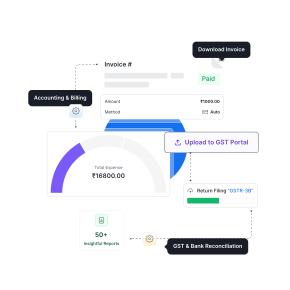
Import Export Code Application: Documents Required
Preparation makes the filing smooth and fast. Gather your files before you log in. The IEC code application documents required are listed below. Keep each scan as a PDF under 5 MB (DGFT).
Here is the standard checklist:
- PAN card of the business or the proprietor.
- Address proof like an electricity bill or rent agreement.
- Bank proof, such as a cancelled cheque or banker’s certificate.
- Aadhaar card of the signatory, used for authentication.
- Incorporation proof for companies, LLPs, or partnerships.
Sole proprietors use their personal PAN. Companies use the business PAN instead. Matching names across documents prevents rejection. That covers the IEC code application documents required for most applicants.
Step-by-Step IEC Code Registration Process
The portal guides you through a clean workflow. Most applicants finish in under thirty minutes. Here is the full IEC code application journey (DGFT).
Step 1: Register on the DGFT portal
Visit dgft.gov.in and create your account. Use a valid email and mobile number. The system sends an OTP for verification. Your profile then links to your PAN.
Step 2: Fill the Application Form
Log in and open “Apply for IEC.” Complete Form ANF-2A with your details. Add your address, bank, and business activity.
Step 3: Upload Documents and Pay
Attach your prepared files to each field. Then pay the ₹500 fee via Bharatkosh. Net banking, UPI, and cards all work.
Step 4: Authenticate and Submit
Sign using Aadhaar OTP or a Digital Signature Certificate (DSC). Review everything once more, then submit. The DGFT usually issues the code within three working days.
After approval, you can download the certificate instantly. Now you are ready to trade and invoice. Many sellers immediately start raising compliant export invoices for their first shipments. Most regular exporters also file a Letter of Undertaking at this stage, letting them ship without paying IGST upfront.
How to Check IEC Code Application Status?
Waiting for approval makes most applicants anxious. The portal lets you track progress live. Learning how to check IEC code application status takes seconds.
Log in to the DGFT portal first. Open the “My IEC” or “View Any IEC” service (DGFT). Enter your IEC and your firm name initials. The screen then shows your current stage.
Common statuses you might see include:
- Under Process: Officers are reviewing your file.
- Approved: Your code is issued and downloadable.
- Pending payment: Your fee did not register.
You can also verify customs transmission here. This confirms your data reached ICEGATE successfully. Knowing how to check IEC code application status prevents shipment surprises. It also flags any required corrections early.
The Mandatory Annual Update Every IEC Holder Must Do
Here lies the rule that catches businesses off guard. Your IEC is valid for life. But it needs one confirmation each year. The DGFT mandates an update between April and June.
This rule came through DGFT Notification 58/2015-2020. It applies even when nothing has changed. You simply log in and confirm your details. Confirmation is completely free within the window.
Miss the June 30 deadline, and the system reacts. Your IEC gets deactivated automatically. A deactivated code blocks every trade activity. You cannot file shipping bills or bills of entry.
You also lose access to RoDTEP scheme refunds during that period. RoDTEP is just one of several export incentive schemes that require a live IEC to claim.
A Real Cost: One Missed Window
Consider an Indian textile exporter named Mehul. His firm ships sarees to buyers in Dubai. He renewed nothing, assuming lifetime meant forever. On July 2, a container stalled at the port. His IEC had quietly deactivated on July 1.
Demurrage charges piled up at ₹8,000 daily. Reactivation took three days through the portal. That single oversight cost him nearly ₹24,000. A free five-minute update would have prevented it.
Why Does the Update Exist?
The logic behind the rule is practical. India needs a clean, current trade database. Outdated addresses and stale bank details cause errors. Annual confirmation keeps customs and DGFT synced. It also reduces fraud and misuse of codes.
Your IEC connects directly to GST on exports and imports, and thus accuracy matters everywhere. It’s also the code referenced whenever you claim a GST refund on exports. So, outdated details can quietly slow that process down too.
Conclusion
The IEC code application is simpler than it appears. A flat ₹500 fee opens global markets. The documents are basic and quick to gather. Approval usually lands within three working days. Yet the work does not end at issuance.
The April-June update keeps your code alive. Treat it as a yearly calendar ritual. Do that, and your trade never stops.
Frequently Asked Questions (FAQs)
What are the total IEC code application fees in 2026?
The government IEC code application fees remain ₹500 for a fresh registration. This is a one-time, non-refundable payment processed via the Bharatkosh gateway. While consultants may charge extra for filing assistance, direct applications carry no additional costs.
Do we need to update the IEC code every year?
Yes, annual updating is a mandatory regulatory requirement enforced by the DGFT. Every IEC holder must log into the portal and confirm or refresh their business details between April and June every year.
What documents do I need for my IEC application as a proprietor?
A proprietor must provide their personal PAN, Aadhaar, address proof, and a cancelled cheque. These form the core IEC code application documents required for the initial filing. Every uploaded document must be a clear PDF under 5 MB to avoid portal rejection.
What documents are required for IEC update?
If you are modifying your profile, you must upload relevant proof. This includes a new cancelled cheque for bank details, an updated electricity bill or rent agreement for address changes, or amended partnership deeds/incorporation certificates for ownership updates.
Are there extra IEC code application charges for the annual update?
Confirming your existing details during the April-June window carries zero IEC code application charges. If you need to modify details like your address or directors, the portal may apply a nominal ₹200 modification fee. Otherwise, staying fully compliant costs you absolutely nothing.
What happens if I miss the annual update deadline?
Your IEC will deactivate automatically immediately after the June 30 deadline passes. This deactivation halts all import and export activities at customs instantly. Reactivating your code requires logging back into the portal and completing the pending update.
How can I update the IEC code in DGFT?
Log into the official DGFT portal, navigate to the ‘Services’ tab, select ‘IEC Profile Management‘, and click on ‘Update/Modify IEC’. Review your pre-populated details, make any necessary modifications, and submit the form using Aadhaar OTP or a Digital Signature Certificate (DSC) for authentication.
How long does DGFT approval take, and how do I track it?
DGFT approval typically takes one to three working days after successful payment and document submission. Applicants can track their live progress by logging into the DGFT portal. Simply open the “View Any IEC” service to monitor the exact stage of your file.
What are the 5 documents used in foreign trade?
The five essential documents required for almost every international trade transaction are the commercial invoice, bill of lading (or airway bill), packing list, certificate of origin, and shipping bill (or bill of entry).
Disclaimer: "This blog post is for informational purposes only. For specific tax advice related to your business, please consult a qualified Chartered Accountant or GST practitioner."
About the author

Jayant is a senior content writer and digital marketer, known for his extensive experience in commercial SEO writing, blog content, website copy, and B2B communication. Since 2019, he has worked on diverse freelance projects across industries. His portfolio includes articles, landing pages, social media content, and web development collaborations. Blending clarity, creativity, and strategic messaging, he specialises in crafting professional, audience-focused content for themunim.com.
Related Articles
Explore the latest market news, useful resources for business, and Munim updates.