Trading Business in India 2026: Types, Benefits, and How to Start a Trading Company
 AuthorMehul Jagwani
 Reviewed ByCA Madhav Bhayani



- How to Start a Trading Company in India: Step-by-Step
- Step 1: Decide the Type of Trading Business and Product Category
- Step 2: Choose a Business Structure
- Step 3: Register the Business
- Step 4: Open a Current Bank Account
- Step 5: Arrange Suppliers and Inventory
- Step 6: Set Up Billing and Accounting
- Step 7: Handle GST Compliance
- Step 8: Set Up Sales Channels
- Types of Trading Business in India
- Wholesale Trading
- Retail Trading
- Import-Export Trading
- Online Trading Business
- Drop Shipping Business
- Commission-Based or Agent Trading
- How to Start a Trading Business from Home
- Conclusion
- Frequently Asked Questions (FAQs)
Summary:
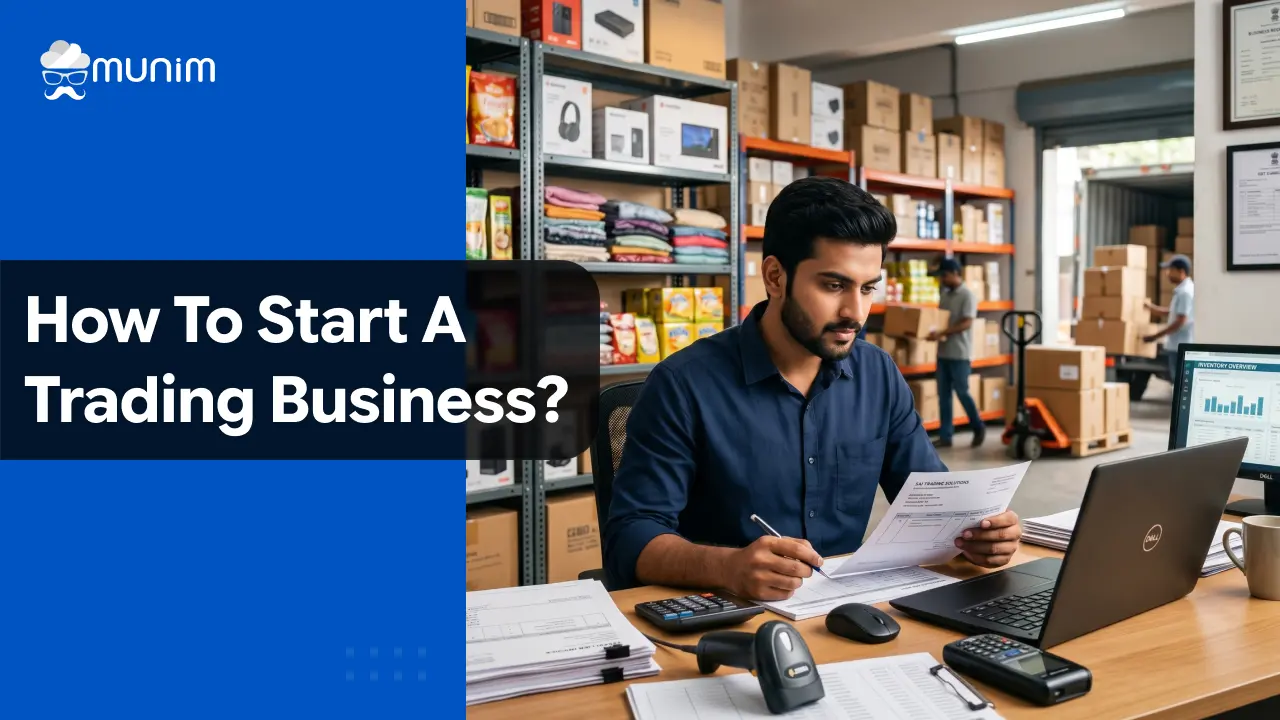
A trading business in India involves buying goods from manufacturers or suppliers and selling them to buyers at a profit. It is one of the most accessible business models for Indian entrepreneurs, with options ranging from wholesale and retail to import-export and online trading.
India’s trading sector has never been more accessible. Whether someone plans to start small from home or launch a registered company with a formal supply chain, the path to starting a trading business in India today is far clearer than it was even five years ago. Digital registrations, GST compliance tools, and e-commerce platforms have removed many of the old barriers. What remains is the need for the right information, a sound plan, and a clear understanding of how the process actually works.
How to Start a Trading Company in India: Step-by-Step
Here is a clear, step-by-step process for anyone looking to start a trading company in India in 2026.
Step 1: Decide the Type of Trading Business and Product Category
The first step is choosing what to trade and in what format. Factors to consider include available capital, market demand in the target geography, supplier access, and whether the business will operate offline, online, or both.
Traders should conduct basic market research before finalising a product category. High-demand categories in 2026 include FMCG, agri-products, electronics, textiles, pharmaceuticals, and home furnishings.
Step 2: Choose a Business Structure
The legal structure determines how the business is taxed, how much compliance is required, and how much personal liability the owner carries. The most common structures for trading businesses in India are:
Sole Proprietorship: Easiest and fastest to set up. Best for very small or home-based traders. No separate legal entity.
Partnership Firm: Suitable for two or more people starting together. Governed by the Partnership Act.
Limited Liability Partnership (LLP): Combines flexibility of a partnership with limited liability. Good for small to mid-sized trading businesses.
Private Limited Company: Best for traders who plan to scale, raise external funding, or work with large institutional buyers. Offers limited liability and a separate legal identity.
Simplify Your Business Operations
Designed to give you speed, control, and accuracy in daily accounting tasks.
 Save time with automated accounting workflows
- Get 35+ detailed business reports easily
- Access your business anytime, anywhere
 Save time with automated accounting workflows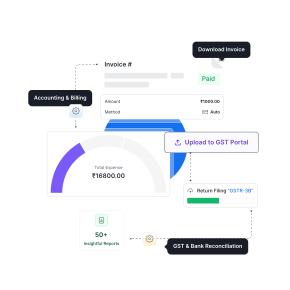
Step 3: Register the Business
For Sole Proprietorships and Partnerships, formal company registration under MCA is not mandatory, but GST registration, PAN, and a trade licence, where required, are essential. For LLPs and Private Limited Companies, registration through the MCA portal is mandatory.
Key registrations required for most trading businesses:
PAN: Mandatory for all business entities for tax purposes.
GST Registration: Mandatory for businesses with an annual turnover exceeding Rs. 40 lakhs for goods traders, or Rs. 20 lakhs in special category states. It is also mandatory for e-commerce sellers and businesses engaged in inter-state trade, regardless of turnover. In 2026, all GST registrations require Aadhaar-based authentication.
MSME/Udyam Registration: Gives access to government schemes, subsidies, and priority lending.
Trade Licence: Required by local municipal authorities in many cities for operating a commercial establishment.
IEC (Import Export Code): Mandatory for all traders involved in importing or exporting goods. Issued online by DGFT.
Step 4: Open a Current Bank Account
A dedicated current bank account in the business name is essential. It keeps personal and business finances separate, makes GST reconciliation easier, and is required by all GST authorities and e-commerce platforms for payout processing.
Step 5: Arrange Suppliers and Inventory
Identifying reliable suppliers is one of the most important steps in building a sustainable trading business. Traders can source from:
- Manufacturers directly, for better margins but higher minimum order quantities
- Wholesale distributors, for lower minimum orders and faster setup
- Government platforms such as GeM for B2G trading
- International suppliers through platforms such as Alibaba for import-focused businesses
Maintaining the right inventory levels is critical to profitability. Overstocking locks up working capital. Understocking leads to missed sales. A dedicated inventory management system helps traders track stock levels in real time and set low-stock alerts.
Step 6: Set Up Billing and Accounting
From the first invoice raised, a trading business must maintain proper books of accounts. This includes purchase records, sales invoices, GST data, expense tracking, and bank reconciliation. Under GST law, every registered trader must file GSTR-1, which covers outward supplies, and GSTR-3B, which is the summary return, every month or quarter depending on turnover.
Using dedicated billing and accounting software from day one saves significant time and reduces errors. It also helps traders manage GST-compliant invoices, purchase records, inventory, expenses, and financial reports from a single dashboard.
Step 7: Handle GST Compliance
GST compliance is non-negotiable for registered trading businesses. Key filing responsibilities include:
GSTR-1: Details of all outward supplies or sales invoices. Filed monthly or quarterly.
GSTR-3B: Monthly summary return covering tax liability, ITC claims, and net tax payment.
GSTR-9: Annual return. Mandatory for businesses with turnover exceeding Rs. 2 crore.
Traders who sell on e-commerce platforms have additional compliance requirements. Platforms collect Tax Collected at Source (TCS) at 1% on the net value of taxable supplies. Traders need to account for this while filing returns.
Munim GST supports filing of GSTR-1, GSTR-3B, and GSTR-9, with direct data import from Excel and Tally. This eliminates manual data entry and significantly reduces the risk of filing errors.
Designed for Modern Tax Professionals
A premium filing solution for CAs and tax consultants who need speed, scale, and operational clarity.
- Handle multiple clients with ease
- Reconcile and validate with confidence
- Overcome the limitations of the GST portal
Step 8: Set Up Sales Channels
Depending on the business model, sales channels may include:
- A physical shop or warehouse
- Listing on Amazon, Flipkart, or Meesho for B2C online sales
- IndiaMART or TradeIndia for B2B leads
- ONDC for multi-platform visibility
- A dedicated website with a payment gateway for D2C sales
- WhatsApp Business for relationship-based selling
For traders moving goods between locations or across states, it is also important to understand e-way bill requirements and generate accurate transport documents whenever applicable.
Types of Trading Business in India
Understanding the different types of trading businesses helps entrepreneurs choose the right model based on capital, market access, and long-term goals.
1. Wholesale Trading
A wholesale trading business buys goods in large quantities directly from manufacturers or importers and sells them to retailers or other businesses in bulk. Margins are lower per unit but volumes are high, which means overall profitability can be substantial.
Common product categories include:
- FMCG goods
- Pharmaceuticals
- Textiles
- Agri-commodities
- Industrial materials
Wholesale traders generally deal with large stock movements, repeat invoices, and frequent transport documentation. In such cases, using GST accounting software helps manage billing, GST data, inventory, and e-way bill-related records more efficiently.
2. Retail Trading
A retail trading business sells goods directly to end consumers. This is the most visible form of trading and includes everything from neighbourhood grocery stores and electronics shops to fashion boutiques. Margins are higher per unit compared to wholesale, and customer relationships are central to growth.
Retail businesses in India operate both offline through physical stores and online through platforms such as Amazon, Flipkart, Meesho, and individual websites. For retail shops, using billing software for retail businesses can simplify invoice generation, purchase orders, GST billing, and daily sales tracking.
3. Import-Export Trading
An import-export trading business operates across international borders. Import businesses bring foreign goods into India for domestic sale or manufacturing. Export businesses send Indian goods to buyers in other countries.
Import-export traders also need to maintain accurate invoices, GST records, bank entries, and compliance documents. If goods are moved within India after import or before export, traders may also need to generate e-way bills using a reliable e-way bill system.
4. Online Trading Business
An online trading business sells goods through e-commerce platforms or a dedicated website. According to IBEF, India’s e-commerce industry was valued at US$ 125 billion, or Rs. 10,82,875 crore, in 2024 and is expected to grow at a CAGR of 27% to reach US$ 163 billion by 2026, and further to US$ 345 billion by 2030. India has already surpassed the United States to become the world’s second-largest e-retail market, with 280 to 300 million online shoppers in 2025. UPI alone processed 20.39 billion transactions worth over Rs. 28.33 lakh crore in January 2026, reflecting how deeply digital payments are embedded in everyday commerce. The opportunity for online traders entering this market has never been larger.
Online traders must also keep a close watch on marketplace invoices, GST reports, TCS entries, refunds, and digital payment records. A tool like Munim Billing and Accounting Software helps simplify these records for small businesses and growing traders.
5. Drop Shipping Business
Drop shipping is a low-capital trading model where the trader accepts customer orders and passes them directly to the supplier, who ships the product. The trader never holds physical inventory. This model is particularly popular for those who want to know how to start a trading business from home without investing in warehousing or stock upfront.
Even without holding stock, drop shipping businesses must maintain proper sales invoices, supplier bills, payment records, and tax data. This makes GST-compliant billing software important from the early stage itself.
6. Commission-Based or Agent Trading
Some traders operate as agents or brokers, facilitating transactions between buyers and sellers without owning the goods. Their income comes from a commission or brokerage fee. This model requires strong market knowledge and an established network.
Commission-based traders must track brokerage income, tax invoices, receipts, and business expenses properly. Using accounting software in India can make this easier, especially when the number of transactions grows.
How to Start a Trading Business from Home
Many traders in India begin from home before moving to a dedicated commercial space. This is entirely possible and legal under the current regulatory framework. Here is what a home-based trader needs:
Registered address: A home address can be used as the registered business address for GST and MSME registration. If the property is rented, the local municipal authority may require a No Objection Certificate (NOC) from the property owner. For sole proprietors, the registration process is straightforward.
Right business model: Drop shipping and online trading are the most practical models for home-based traders since they do not require space for storing large quantities of inventory. Traders who do hold stock at home should ensure their inventory is insured and properly recorded in their books.
Compliant billing setup: Every sale must be supported by a GST-compliant invoice. Using billing software ensures invoices are generated in the correct format, with the right HSN codes, GST rates, and buyer details populated automatically.
Conclusion
Starting a trading business in India in 2026 is more straightforward than it has ever been. The combination of digital registrations, e-commerce infrastructure, government support schemes, and cloud-based compliance tools has lowered the barriers significantly. Whether the goal is to start a small trading business from home or to launch a formally registered trading company with a national distribution network, the process follows a clear sequence: choose the right structure, complete the required registrations, build supplier relationships, and manage finances and GST compliance properly from day one.
For traders who want to manage billing, GST returns, e-way bills, inventory, and financial records without switching between multiple tools, Munim Billing and Accounting Software can be a practical solution to start with.
Frequently Asked Questions (FAQs)
Is GST registration mandatory for a trading business?
GST registration is mandatory if annual turnover exceeds Rs. 40 lakhs, or Rs. 20 lakhs in special category states, for goods traders. It is also mandatory for all e-commerce sellers and traders engaged in inter-state supply, regardless of turnover.
Can a trading business opt for the GST Composition Scheme?
Yes. Goods traders with annual turnover up to Rs. 1.5 crore can opt for the Composition Scheme. They pay GST at a flat 1% on turnover and file returns quarterly. However, they cannot issue a tax invoice or claim ITC under this scheme.
What documents are required to start a trading company in India?
Commonly required documents include PAN card, Aadhaar card, address proof for the business premises, a cancelled cheque or bank statement for the current account, passport-sized photographs of directors or proprietors, and the Memorandum and Articles of Association for Private Limited Companies.
Disclaimer: "This blog post is for informational purposes only. For specific tax advice related to your business, please consult a qualified Chartered Accountant or GST practitioner."
About the author

Mehul is a seasoned content writer with a passion for simplifying complex accounting and GST topics. With a keen interest in entrepreneurship and business management, he specializes in creating informative and engaging content for themunim.com. His goal is to help businesses understand and implement accounting and GST software solutions effectively. When he's not crafting content, Mehul enjoys exploring new places and spending time with his Golden Retriever.
Related Articles
Explore the latest market news, useful resources for business, and Munim updates.