Which Customers Should You Follow Up With First? How to Use Accounts Receivable Ageing
 AuthorMehul Jagwani
 Reviewed ByAjay Savani




Summary:
Accounts receivable ageing helps businesses identify which customers need payment follow-up first by reviewing overdue days, outstanding amounts, payment history and disputes. This guide explains how to prioritise collections, improve cash flow and use Munim Billing & Accounting to track invoices, balances, receipts and customer dues efficiently.
If your business sells on credit such as a wholesaler, distributor, manufacturer or service provider offering 15, 30 or 45 days to pay overdue invoices can quickly affect cash flow.
When several customers owe money, the accounts team may not know whom to contact first. Accounts Receivable Ageing helps prioritise follow-ups by showing which balances are older, larger or linked to missed payment commitments.
But the oldest invoice should not always come first. Payment history, disputes and total customer exposure also matter.
What Is Accounts Receivable Ageing?
Accounts Receivable Ageing is the process of organising outstanding customer invoices according to their age. It shows how much each customer owes and how long each amount has remained unpaid.
An ageing report normally contains:
- Customer name
- Invoice number
- Invoice date
- Payment due date
- Original invoice amount
- Payments or adjustments received
- Remaining balance
- Number of overdue days
- Ageing bucket
- Total customer balance
The report answers three important questions:
- How much money is outstanding?
- How long has each invoice remained unpaid?
- Which customer should the collection team contact first?
Simplify Your Business Operations
Designed to give you speed, control, and accuracy in daily accounting tasks.
 Save time with automated accounting workflows
- Get 35+ detailed business reports easily
- Access your business anytime, anywhere
 Save time with automated accounting workflows
Priority Matrix: Which Customers Should a Business Follow Up With First?
A business should begin with customers whose balances are old, large, undisputed and linked to missed commitments. The following order provides a practical starting point.
Priority 1: Customers Who Have Broken a Payment Promise
A promised payment date is more useful than a vague response such as “payment is under process.” If the customer has missed a confirmed date, the account should move to the top of the collection list.
The follow up should mention:
- Invoice number
- Outstanding amount
- Original due date
- Promised payment date
- Request for payment reference or a revised confirmed date
Repeated broken promises may indicate a cash problem, an internal approval issue or deliberate delay.
Priority 2: Large Balances in Older Ageing Buckets
Customers with significant amounts in the 61 to 90, 91 to 120 or more than 120 day buckets can materially affect cash availability.
The accounts team should review both:
- The oldest individual invoice
- The customer’s total outstanding balance
A customer may have one invoice of ₹1 lakh that is 95 days overdue and five newer invoices totalling ₹7 lakh. The total exposure is ₹8 lakh, not ₹1 lakh.
Priority 3: Customers Approaching a Credit Limit
A customer can become a collection priority even when only part of the balance is overdue. If the total outstanding amount is close to or above the approved credit limit, new sales can increase the risk.
Before accepting another credit order, the sales and accounts teams should review:
- Existing outstanding balance
- Unbilled deliveries
- Open sales orders
- Available credit limit
- Recent payment behaviour
This prevents the sales team from extending further credit without visibility into earlier dues.
Priority 4: Undisputed Invoices That Can Be Collected Quickly
Some overdue invoices require only a copy of the invoice, proof of delivery or bank details. These balances are often easier to collect than disputed invoices.
Quick collections improve cash flow while the team works separately on complex cases.
Clear invoice payment terms can reduce such delays by stating the due date, payment method and agreed conditions upfront.
Priority 5: Customers With Open Disputes
A disputed invoice should not remain in the same collection queue as an undisputed invoice. The collection team may be unable to secure payment until the underlying issue is resolved.
Common disputes include:
- Incorrect quantity
- Wrong GSTIN
- Rate difference
- Missing purchase order
- Missing proof of delivery
- Service quality issue
- Unrecorded credit note
- Incorrect tax calculation
The account still needs urgent attention, but the next action should be dispute resolution rather than another generic payment reminder.
Read more: Payable & Receivable
A Practical Debtor Ageing Analysis Example
Consider a wholesale electrical goods business reviewing receivables on 31 August 2026.
| Customer | Outstanding amount | Oldest overdue invoice | Payment status | Initial priority |
| Customer A | ₹4,80,000 | 96 days | Promised date missed twice | Very high |
| Customer B | ₹7,50,000 | 18 days | No dispute, usually pays late | High |
| Customer C | ₹1,25,000 | 72 days | Rate dispute pending | High, but assign to dispute owner |
| Customer D | ₹65,000 | 35 days | Invoice copy requested | Medium |
| Customer E | ₹3,20,000 | Current | Due in five days | Pre due reminder |
| Customer F | ₹18,000 | 105 days | No recent contact | Medium to high |
A sensible order would be:
- Customer A: Large balance, old invoices and two broken promises.
- Customer B: Largest exposure, even though the delay is relatively recent.
- Customer C: The dispute needs immediate resolution before collection can proceed.
- Customer E: A pre due confirmation can prevent a large balance from becoming overdue.
- Customer F: The invoice is old, but the value is smaller.
- Customer D: The required invoice copy can be sent through a standard response.
This method is more useful than sorting only by overdue days or only by invoice value.
How Munim Helps Businesses Track Outstanding Receivables
The accounts team can follow this process:
1. Create the sales invoice in Munim with the correct customer and payment terms.
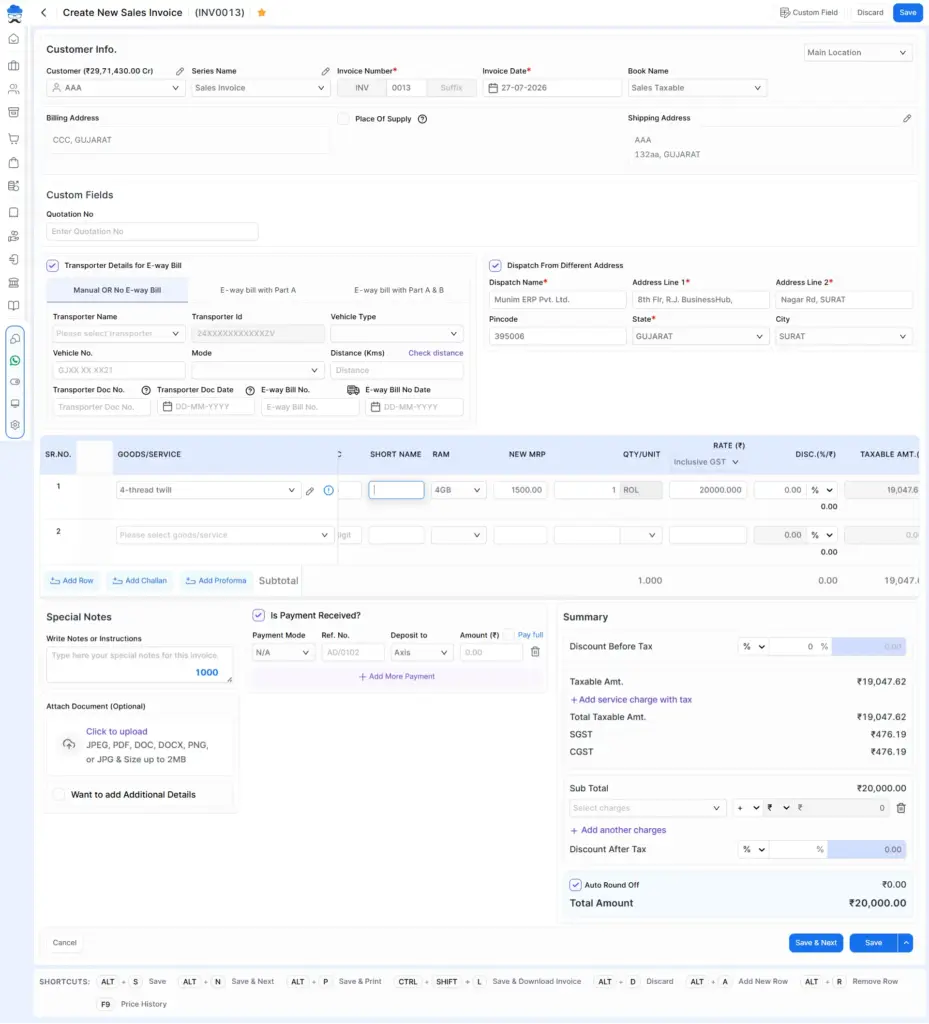
2. Record receipts, part payments, credit notes and sales returns promptly.
3. Review the customer and Invoice-wise report
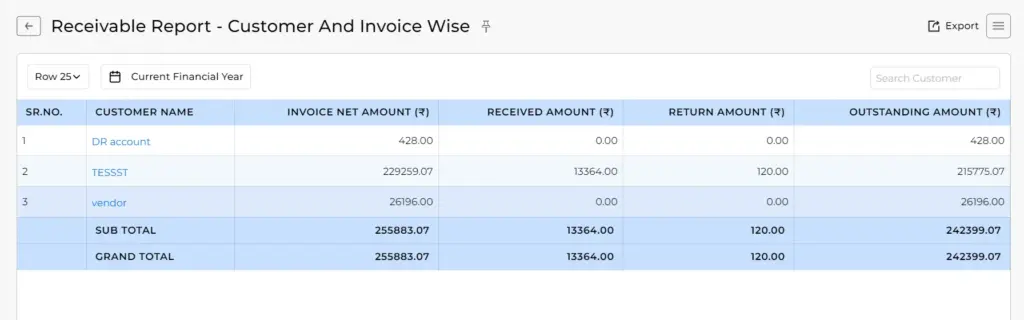
4. Identify invoices that have crossed their due dates.
5. Prioritise customers based on overdue period, balance and payment history.
6. Contact the customer with the invoice number, amount and due date.
7. Record the payment when received and verify the revised balance.
This connects everyday invoicing with the payment collection process. The business gets a clearer view of how much each customer owes before deciding whom to follow up with first.
The Bottom Line
Accounts Receivable Ageing helps businesses focus on the customers that need attention first instead of following up randomly. By reviewing overdue days, outstanding amounts, payment history and disputes together, the accounts team can make collections more organised and improve cash flow.
With Munim Billing & Accounting, businesses can track invoices, customer balances, receipts and outstanding amounts in one place.
Ready to manage receivables more efficiently? Sign up for Munim Billing & Accounting and start your 7-day free trial.
Frequently Asked Questions
Is an outstanding invoice always overdue?
No. An outstanding invoice is any unpaid invoice, while an overdue invoice has crossed its payment due date.
Should ageing be calculated from the invoice date or due date?
For collection purposes, ageing is usually more meaningful when calculated from the payment due date.
How do part payments affect debtor ageing analysis?
A part payment reduces the outstanding invoice balance but does not close the invoice. The remaining amount continues to appear in the relevant ageing bucket until it is paid or adjusted.
What is a healthy receivables ageing report?
A healthy report contains a high proportion of current or recently due balances and relatively little value in older buckets. The appropriate level depends on the industry, agreed credit terms and customer mix.
Can accounting software improve overdue invoice tracking?
Yes. Accounting software can bring invoices, receipts, credit notes, customer balances and outstanding amounts into one record. Its usefulness still depends on timely entries, correct payment allocation and regular reconciliation.
Disclaimer: "This blog post is for informational purposes only. For specific tax advice related to your business, please consult a qualified Chartered Accountant or GST practitioner."
Related Articles
Explore the latest market news, useful resources for business, and Munim updates.