GST Registration for Small E-Commerce Sellers: What Changes From November 1, 2026
 AuthorMehul Jagwani
 Reviewed ByCA Madhav Bhayani



- What Is the New GST Registration Scheme for E-Commerce Sellers?
- Who Is Eligible for GST Registration Under Rule 14B?
- How to Apply for GST Registration Under Rule 14B
- What Are Your Obligations After Registration?
- Can You Obtain Multiple Registrations or Withdraw From Rule 14B?
- How Can Munim Help You Manage GST Compliance After Registration?
- Simplify Your GST Return Filing With Munim
- Frequently Asked Questions (FAQs)
Summary:
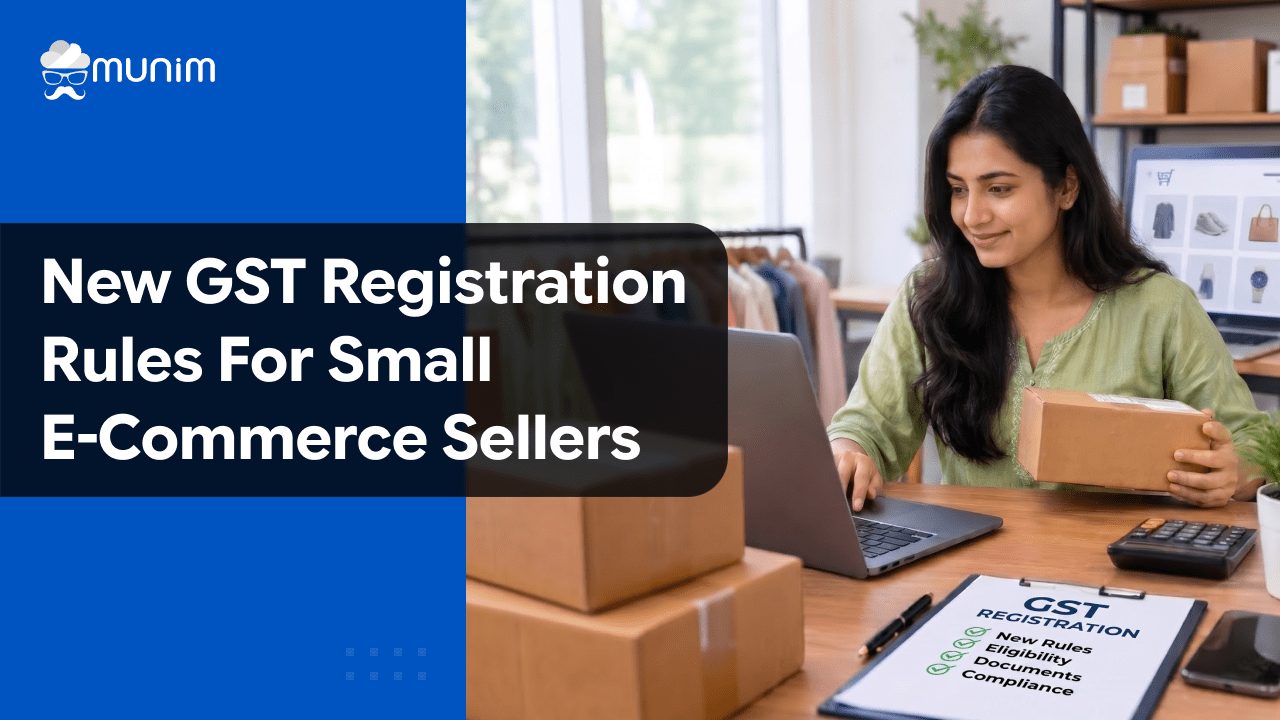
GST registration for small e-commerce sellers will become simpler from November 1, 2026, under Rule 14B of the CGST Rules. Eligible sellers can obtain GST registration in another State or Union Territory without having their own physical premises there. Instead, they can use an e-commerce operator’s (ECO) warehouse as their Principal Place of Business (PPoB). The scheme is optional and requires an existing home-State GST registration, ECO consent and compliance with the ₹2.5 lakh monthly output tax liability condition on specified supplies.
Selling on e-commerce platforms and planning to expand into other States?
Until now, arranging a place of business for GST registration in another State could be difficult for smaller sellers.
The government has introduced a GST relaxation for e-commerce businesses to address this. From November 1, 2026, eligible sellers can use an ECO warehouse as their Principal Place of Business in a State where they have no physical presence.
We’ve gone through the notification and broken down what Rule 14B means for you: who is eligible, how to apply, and what your obligations are after registration.
What Is the New GST Registration Scheme for E-Commerce Sellers?
Under Notification No. 05/2026–Central Tax, dated October 26, 2026, the government introduced Rule 14B of the CGST Rules, effective November 1, 2026.
The rule allows eligible sellers supplying goods through e-commerce operators covered under Section 52 of the CGST Act to obtain registration in another State without maintaining their own physical premises there.
They can instead declare an eligible ECO warehouse as their Principal Place of Business, subject to the operator’s consent.
What has changed?
| Earlier | From November 1, 2026 |
| Arranging an eligible place of business in another State could be challenging. | Eligible sellers can declare an ECO warehouse as their PPoB. |
| Expanding into multiple States could require additional premises-related arrangements. | Eligible sellers can register without having their own physical presence in those States. |
| Managing multi-State registrations could create operational hurdles. | Rule 14B provides an optional, simplified registration mechanism. |
Who Is Eligible for GST Registration Under Rule 14B?
To use the new GST registration for small e-commerce sellers, you must meet these conditions:
- Existing GST registration: You must hold a regular GST registration in your home State where your business has physical presence.
- E-commerce supplies: You must intend to supply goods only through ECOs required to collect TCS under Section 52.
- No physical presence: You must not have your own physical presence in the State/UT where you seek Rule 14B registration.
- Monthly tax liability: Your total CGST, SGST/UTGST and IGST output tax liability on supplies to registered persons, excluding those registered under the same PAN, must not exceed ₹2.5 lakh per month.
- ECO consent: The e-commerce operator must agree to its warehouse being declared as your Principal Place of Business.
- Verification: You must complete the prescribed Aadhaar authentication and verification requirements.
Important: The ₹2.5 lakh limit applies to specified monthly output tax liability, not turnover.
If you need assistance with GST registration or compliance, you can also explore our guide on GST Suvidha Kendra franchise to understand how GST-related assistance services work.
Designed for Modern Tax Professionals
A premium filing solution for CAs and tax consultants who need speed, scale, and operational clarity.
 Handle multiple clients with ease
- Reconcile and validate with confidence
- Overcome the limitations of the GST portal
 Handle multiple clients with ease
How to Apply for GST Registration Under Rule 14B
You can apply through the official GST Portal by following these steps.
- Submit FORM GST REG-01: Apply for registration in the relevant State/UT and opt for Rule 14B.
- Enter your home-State GSTIN: Provide your existing GSTIN registered under the same PAN.
- Declare ECO warehouse details: Enter the warehouse address as your PPoB. Add other eligible ECO warehouses as Additional Places of Business (APoB), if applicable.
- Obtain ECO consent: The application is forwarded to the ECO, which has seven working days to provide consent.
- Complete verification: Undergo the prescribed biometric Aadhaar authentication, document verification and home-State physical verification, where required.
- Receive GST registration: Registration is granted electronically after successful verification and fulfilment of the required conditions.
If the ECO does not provide the necessary consent within seven working days, the application cannot proceed under this scheme.
If you use a Digital Signature Certificate (DSC) for GST-related submissions, we recommend following our step-by-step guide on how to install GST emSigner to set up the utility and avoid technical issues during DSC-based authentication.
What Are Your Obligations After Registration?
The latest GST update simplifies registration, but your regular GST compliance obligations continue.
We recommend keeping track of these requirements:
| Requirement | What You Must Do |
| Books of accounts | Maintain records, including electronic data, at your home-State PPoB. |
| Warehouse changes | Apply for amendments through FORM GST REG-14. |
| ECO consent withdrawal | Submit the required amendment within 30 days of the ECO’s withdrawal intimation. |
| GST returns | Continue filing applicable GST returns and paying taxes. |
| Registration certificate | You need not display your GST certificate or GSTIN on the name board at the ECO warehouse. |
Remember: Your Rule 14B registration may be deemed cancelled if your home-State registration is cancelled or you fail to amend your registration within the prescribed period after ECO consent is withdrawn.
Can You Obtain Multiple Registrations or Withdraw From Rule 14B?
Here are three important points:
- One registration per State/UT: Only one Rule 14B registration can be obtained against a PAN in a particular State or UT.
- Withdrawal: You can withdraw from the simplified scheme by submitting FORM GST REG-32, subject to the prescribed conditions.
- Existing Rule 14A registration: If your home-State registration is under Rule 14A, you must first apply to withdraw from that option through FORM GST REG-32 before applying under Rule 14B in another State.
How Can Munim Help You Manage GST Compliance After Registration?
Once you obtain your new GSTIN, you must manage applicable GST returns and maintain accurate sales records.
With Munim GST, you can manage GSTR-1 and GSTR-3B filing, import sales data and track return status across multiple GSTINs.
Our GSTR-1 workflow also supports an Ecommerce Excel Template for importing e-commerce sales data.
Already using Munim?
You can follow these steps:
- Add the newly obtained GSTIN to your company/client list.
- Select the relevant company and open Return > GSTR-1.
- Choose Import Your Data and select the appropriate supported import format.
- Verify your sales data before proceeding with return filing.
For detailed instructions, refer to our GSTR-1 Filing Helpdesk Guide.
Simplify Your GST Return Filing With Munim
In this blog, we covered the key points of the new Rule 14B: the eligibility conditions, the registration steps, the obligations that continue after registration, and how to manage returns across multiple GSTINs. Registration is easier now, but managing sales records, GST returns and compliance across different GSTINs still needs attention.
With Munim GST, you can organise e-commerce sales data, manage GST reconciliation and file returns through one platform.
Start your 7-day free trial of Munim GST.
Frequently Asked Questions (FAQs)
1. Is GST registration mandatory for small e-commerce sellers under Rule 14B?
No. Rule 14B is an optional simplified registration scheme for eligible e-commerce sellers. It does not remove any GST registration obligation that applies under the existing law.
2. Can I sell products outside e-commerce platforms after registering under Rule 14B?
No. A Rule 14B registration can be used only for supplying goods through e-commerce operators required to collect TCS under Section 52 of the CGST Act.
3. Can I use multiple e-commerce warehouses under one GST registration?
Yes. You can declare one eligible ECO warehouse as your Principal Place of Business and other eligible warehouses in the same State/UT as Additional Places of Business, subject to ECO consent.
Disclaimer: "This blog post is for informational purposes only. For specific tax advice related to your business, please consult a qualified Chartered Accountant or GST practitioner."
About the author

Mehul is a seasoned content writer with a passion for simplifying complex accounting and GST topics. With a keen interest in entrepreneurship and business management, he specializes in creating informative and engaging content for themunim.com. His goal is to help businesses understand and implement accounting and GST software solutions effectively. When he's not crafting content, Mehul enjoys exploring new places and spending time with his Golden Retriever.
Post Tags
Related Articles
Explore the latest market news, useful resources for business, and Munim updates.