HSN Code Reporting in GSTR-1 for B2B and B2C Supplies: Updated Rules for Phase 3 (May 2025 Onwards)
 AuthorMehul Jagwani
 Reviewed ByMadhav Bhayani



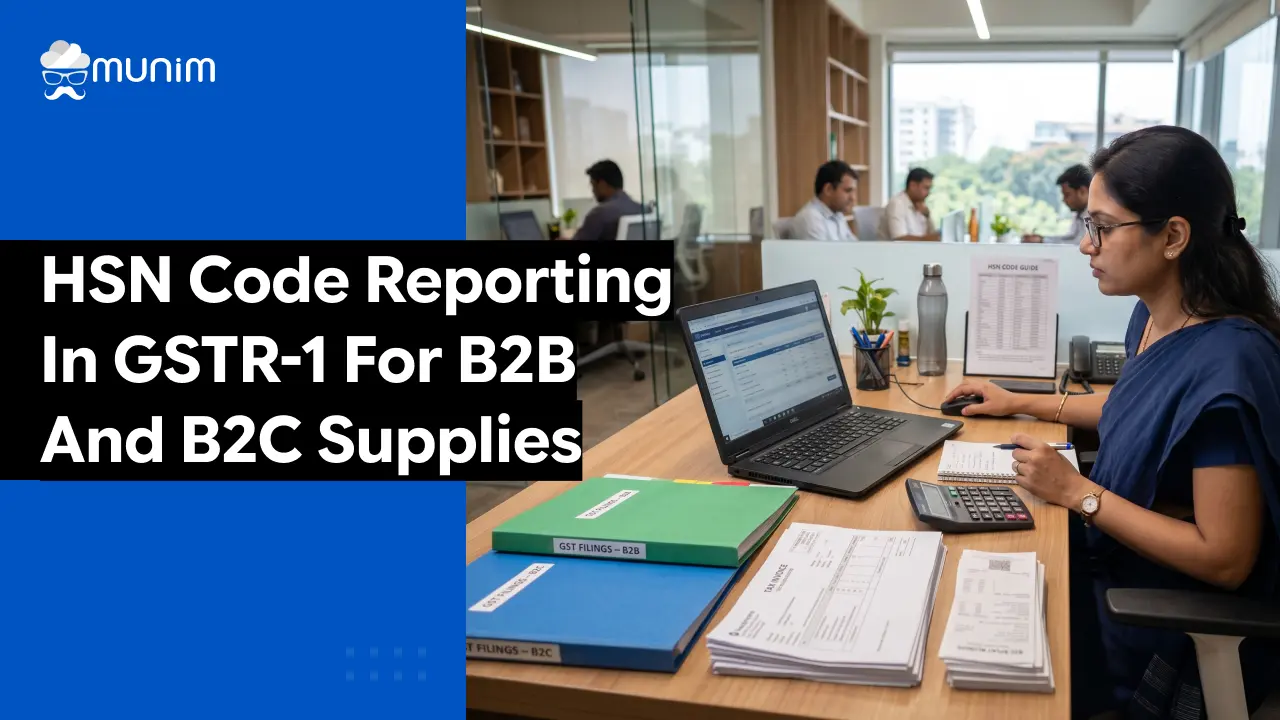
When it comes to GSTR-1 filing, one area that continues to create confusion for businesses and tax professionals alike is HSN code reporting in GSTR-1. The rules differ for B2B and B2C supplies, the number of digits required varies by annual turnover, and the GST portal has gone through significant structural changes since May 2025. This post breaks down exactly what applies to whom, what has changed in each phase, and how to stay compliant without second-guessing every entry.
HSN Reporting Phases at a Glance
| Phase | Period | AATO | HSN Digits Required | Manual Entry |
| Phase 1 Part 1 | Apr 2022 to Jul 2022 | Up to Rs. 5 crore | 2 digits | Allowed (warning only) |
| Phase 1 Part 1 | Apr 2022 to Jul 2022 | Above Rs. 5 crore | 4 digits | Allowed (warning only) |
| Phase 1 Part 2 | Aug 2022 to Oct 2022 | Up to Rs. 5 crore | 2 digits | Allowed (warning only) |
| Phase 1 Part 2 | Aug 2022 to Oct 2022 | Above Rs. 5 crore | 6 digits | Allowed (warning only) |
| Phase 2 | Nov 2022 to Apr 2025 | Up to Rs. 5 crore | 4 digits | Allowed (warning only) |
| Phase 2 | Nov 2022 to Apr 2025 | Above Rs. 5 crore | 6 digits | Allowed (warning only) |
| Phase 3 | May 2025 onwards | Up to Rs. 5 crore | 4 digits | Not allowed (dropdown only) |
| Phase 3 | May 2025 onwards | Above Rs. 5 crore | 6 digits | Not allowed (dropdown only) |
Phase 4 is yet to be announced by GSTN.
What is Table 13 in GSTR-1 and why is it now mandatory?
Table 13 is one of the most important additions to come out of Phase 3. Effective from the May 2025 return period, it is now mandatory for all regular taxpayers filing GSTR-1 or GSTR-1A.
What Does Table 13 Capture?
Table 13 requires taxpayers to report a summary of all documents issued during the return period. This is not a narrative or a description. It is a structured, count-based summary that tells the tax department how many of each type of document were issued, what number series they follow, and whether that count aligns with what has actually been reported in the return.
The documents that must be covered under Table 13 include:
- Tax invoices (both original and revised)
- Credit notes issued against original supplies
- Debit notes issued for supplementary charges
- Delivery challans issued where a tax invoice is not applicable
- Receipt vouchers, refund vouchers, and payment vouchers where applicable
For each document type, the taxpayer needs to report the opening serial number, the closing serial number, the total number of documents issued, and the number of documents that have been cancelled. The portal then cross-checks these document counts against the actual invoice and note-level data reported in other GSTR-1 tables.
Designed for Modern Tax Professionals
A premium filing solution for CAs and tax consultants who need speed, scale, and operational clarity.
 Handle multiple clients with ease
- Reconcile and validate with confidence
- Overcome the limitations of the GST portal
 Handle multiple clients with ease
HSN Code Reporting in GSTR-1: B2B vs B2C Rules Explained
B2B Supplies: HSN Code is Compulsory in GSTR-1
For all B2B supplies, HSN code reporting in GSTR-1 is mandatory without exception. There is no turnover threshold that exempts a taxpayer from this requirement. Whether the AATO is Rs. 50 lakh or Rs. 500 crore, the B2B tab in Table 12 must be filled accurately.
CBIC confirmed this on June 10, 2025, via its official X account. The clarification was clear: if B2B supplies are reported in any section of GSTR-1, the B2B tab in Table 12 cannot be left blank. The GST portal enforces this through system validations, and a mismatch between the B2B tab values and the invoice-level supply tables will trigger a warning.
It is worth noting that despite the warning, taxpayers can technically proceed and file the return. However, the discrepancy is recorded and can attract further scrutiny during audits or assessments.
B2C Supplies: Conditional Exemption Based on Turnover
For B2C supplies, the rules are more nuanced and are governed by Notification No. 12/2017 Central Tax dated June 28, 2017 (as amended).
Under this notification, a registered person with aggregate annual turnover up to Rs. 5 crore in the preceding financial year is not required to mention HSN codes in tax invoices issued to unregistered persons. As a result, the B2C tab in Table 12 is optional for such taxpayers. The GSTN portal currently does not enforce mandatory validation for B2C HSN entries, and the tab can be left blank.
For taxpayers with AATO above Rs. 5 crore, HSN reporting is required for B2C supplies as well, and the minimum digit requirement of 6 digits applies.
HSN Reporting in GSTR-1 for Service Providers
A common query from service providers is whether these rules apply to them as well.
They do. For services, the equivalent of HSN is the SAC (Services Accounting Code). Service providers follow the same digit requirement based on AATO: 4-digit SAC for AATO up to Rs. 5 crore and 6-digit SAC for AATO above Rs. 5 crore.
The same B2B mandatory and B2C optional logic applies. A service provider making B2B supplies must report the SAC code in the B2B tab of Table 12, regardless of turnover. For B2C service supplies, the exemption for taxpayers below Rs. 5 crore AATO holds.
What Is the HSN Wise Summary in GSTR-1?
The HSN wise summary in GSTR-1 (Table 12) is a consolidated statement of all supplies made during the return period, grouped by HSN code. For each HSN code, the taxpayer needs to report:
- The HSN code (selected from the dropdown)
- The Unit of Quantity Code (UQC)
- Total quantity of goods supplied
- Total taxable value
- Applicable tax rate
- Central tax (CGST), State/UT tax (SGST/UTGST), and Integrated tax (IGST) amounts
- Cess, if applicable
This summary does not list individual invoices. It is an aggregated view. Individual invoice details go into other tables of GSTR-1 (such as Table 4 for taxable outward supplies to registered persons, Table 5 for taxable outward inter-state supplies to unregistered persons, and so on).
The purpose of Table 12 is to give tax authorities a bird’s-eye view of what categories of goods and services a taxpayer is supplying, at what rates, and in what volumes. To understand the basic framework behind HSN classification itself, see what HSN codes mean under GST and how they are structured across goods and services.
Frequently Asked Questions (FAQs)
Q1. Is HSN code compulsory in GSTR-1 for all taxpayers?
HSN code is compulsory in GSTR-1 for all B2B supplies, regardless of the taxpayer’s turnover. For B2C supplies, it is optional for taxpayers with aggregate annual turnover up to Rs. 5 crore in the preceding financial year. Taxpayers with AATO above Rs. 5 crore must report HSN codes for both B2B and B2C supplies.
Q2. What is the HSN wise summary in GSTR-1?
The HSN wise summary in GSTR-1 is reported in Table 12. It is a consolidated statement of all outward supplies grouped by HSN code, showing taxable value, applicable GST rate, and tax amounts. From May 2025, Table 12 has two separate tabs: one for B2B supplies and one for B2C supplies.
Q3. How many digits of HSN code are required in GSTR-1?
Taxpayers with AATO up to Rs. 5 crore must report a minimum 4-digit HSN code. Taxpayers with AATO above Rs. 5 crore must report a minimum 6-digit HSN code. For export and import transactions, an 8-digit HSN code is required as per customs regulations.
Conclusion
HSN code reporting in GSTR-1 is no longer a simple optional checkbox. With Phase 3 now in effect since May 2025, the structure of Table 12 has changed, validations have tightened, and the distinction between B2B and B2C reporting has been formally built into the filing workflow.
The core rule is straightforward: HSN is compulsory for all B2B supplies, irrespective of turnover. For B2C supplies, taxpayers with AATO up to Rs. 5 crore have the option to skip it, while those above that threshold must report it for both categories.
Disclaimer: "This blog post is for informational purposes only. For specific tax advice related to your business, please consult a qualified Chartered Accountant or GST practitioner."
About the author

Mehul is a seasoned content writer with a passion for simplifying complex accounting and GST topics. With a keen interest in entrepreneurship and business management, he specializes in creating informative and engaging content for themunim.com. His goal is to help businesses understand and implement accounting and GST software solutions effectively. When he's not crafting content, Mehul enjoys exploring new places and spending time with his Golden Retriever.
Related Articles
Explore the latest market news, useful resources for business, and Munim updates.