Proprietorship Firm in India: Meaning, Registration, Fees, PAN, Tax & Bank Account
 AuthorMehul Jagwani
 Reviewed ByCA Ajay Savani



- Proprietorship Firm Meaning: What Does It Actually Mean?
- Which Registrations Can Establish a Proprietorship Firm?
- How to Complete Proprietorship Firm Registration Online
- Documents Commonly Required for Proprietorship Registration
- Proprietorship Firm Registration Fees
- Does a Proprietorship Firm Need a Separate PAN?
- Does a Proprietorship Firm Need GST Registration?
- Does a Proprietorship Need a Separate Business Bank Account?
- How Does a Proprietor Pay Income Tax?
- Proprietorship Firm: Advantages and Limitations
- Keep Your Proprietorship Accounts Organised With Munim
- Common Questions About Proprietorship Firms

Summary:
A proprietorship firm in India is a business owned and controlled by one individual, with no separate legal identity from its proprietor. There is no single central registration or incorporation process for a sole proprietorship. Instead, you establish the business through applicable registrations such as Udyam, GST, Shop and Establishment registration, FSSAI or other licences based on your activity.
You want to start a small trading, retail, manufacturing or service business. Or, as a CA, you have a client asking you to “register a proprietorship firm.”
The first question usually is: Where is the proprietorship registration portal?
There isn’t one.
Unlike a company or LLP, a proprietorship firm does not have a single incorporation process. You establish the business through the registrations and licences that apply to its activity.
In this guide, we’ll explain what a proprietorship means, how to register one, which documents and fees may apply, how PAN and GST work, how the proprietor is taxed and what you need to open a business bank account.
Proprietorship Firm Meaning: What Does It Actually Mean?
A proprietorship firm, also called a sole proprietorship, is a business owned, managed and controlled by one person.
The proprietor and the business are not legally separate persons. The Supreme Court has reiterated that a proprietorship is not a separate legal entity; it is essentially the business name under which the proprietor operates.
That creates a few important characteristics:
| Area | Sole Proprietorship |
| Owners | One individual |
| Separate legal entity | No |
| Separate incorporation | No |
| Business control | With the proprietor |
| Profit | Belongs to the proprietor |
| Liability | Generally unlimited |
| PAN | Proprietor’s individual PAN |
| Income tax | Taxed in the proprietor’s hands |
| Business licences | Based on activity, state and turnover |
Which Registrations Can Establish a Proprietorship Firm?
1. Udyam Registration
If your business qualifies as a micro, small or medium enterprise, you can register through the government’s Udyam Registration Portal.
For proprietorships, the Aadhaar used for Udyam registration is the proprietor’s Aadhaar.
Udyam registration is:
- online;
- paperless;
- based on self-declaration; and
- free of government registration fees.
From 1 April 2025, the MSME classification limits are:
| Category | Investment Limit | Turnover Limit |
| Micro | Up to ₹2.5 crore | Up to ₹10 crore |
| Small | Up to ₹25 crore | Up to ₹100 crore |
| Medium | Up to ₹125 crore | Up to ₹500 crore |
Both the applicable investment and turnover conditions are relevant for classification.
Udyam registration does not incorporate your proprietorship as a separate legal entity. It gives the enterprise formal MSME registration.
2. GST Registration
A proprietorship may also need GST registration depending on its aggregate turnover and the nature of its supplies.
As a broad threshold guide, CBIC states that the registration threshold is generally:
| Business Type | General Threshold |
| Suppliers of services | ₹20 lakh |
| Exclusive suppliers of goods in states that adopted the enhanced limit | ₹40 lakh |
Lower thresholds apply in certain states, and compulsory-registration provisions and exemptions can change whether registration is required in a particular case.
One important point for proprietors is that aggregate turnover is calculated on a PAN basis across India.
So, if the same individual operates more than one business under the same PAN, you cannot necessarily test the GST threshold separately for each trade name.
The GST Portal also specifically allows the PAN of the proprietor to be entered while applying for GST registration.
3. Shop and Establishment or Local Registration
Depending on the state and nature of your premises, Shop and Establishment registration or another local registration may apply.
Requirements, fees, employee thresholds and processes differ between states.
4. Industry-Specific Registrations
Some businesses require additional approvals regardless of whether they operate as proprietorships.
For example:
- food businesses may require FSSAI registration or licensing;
- importers and exporters may require an IEC;
- pharmacies require relevant drug licences;
- certain manufacturers require pollution, factory or local approvals;
- professional activities may require registrations from relevant professional bodies.
The business structure does not replace these sector-specific obligations.
How to Complete Proprietorship Firm Registration Online
The following is the process of registering proprietorship firm to register online:
Step 1: Decide Your Business Name
Choose the trade name you want customers to recognise.
For example:
Proprietor: Rahul Mehta
Trade Name: RM Office Supplies
The trade name does not create a separate legal person.
You should also check whether the name conflicts with an existing trademark before building your brand around it.
Step 2: Keep the Proprietor’s PAN and Aadhaar Ready
Because the proprietor and proprietorship are not separate legal entities, the proprietor’s PAN is generally used for the business.
Aadhaar is also required for processes such as Udyam registration and may be used for authentication in other registrations.
Step 3: Confirm Your Business Address
Keep suitable proof of your principal business premises.
The exact documents depend on the registration being obtained and whether the premises are:
- owned;
- rented;
- leased; or
- being used with the owner’s consent.
Do not assume that one address document will satisfy every authority. If you use premises with the owner’s permission, check the consent letter for GST registration requirements.
Step 4: Identify Which Registrations Apply
Before submitting applications, check whether you actually need:
- GST;
- Udyam;
- Shop and Establishment;
- Professional Tax;
- FSSAI;
- IEC;
- municipal licence; or
- any sector-specific approval.
For CAs handling proprietorship firm registration for clients, this step is particularly important because two clients operating from the same city may still require different registrations based on their activity.
Step 5: Apply on the Relevant Government Portals
If Udyam applies, use the official Udyam portal.
If GST applies, use the GST Portal. Follow the GST registration process to prepare your application.
For other licences, use the relevant central, state or municipal authority.
Do not treat a private registration website as the government authority simply because it appears for a search such as register proprietorship firm online.
Step 6: Open a Business Bank Account
Once you have sufficient business proof, approach your bank to open an account in the proprietorship’s trade name.
We’ll explain RBI’s documentation guidance later in this article.
Step 7: Set Up Your Accounting and Billing
Once the business starts operating, separate personal and business records as far as practically possible.
Maintain records for:
- sales;
- purchases;
- expenses;
- customer receivables;
- vendor payables;
- inventory, where applicable;
- bank transactions;
- GST records, where applicable; and
- financial statements.
This becomes increasingly important once turnover and transaction volume increase. For businesses handling stock, see how to track inventory with accounting software.
Documents Commonly Required for Proprietorship Registration
There is no universal “proprietorship document list” because there is no universal proprietorship registration.
However, the following documents are commonly needed across different processes:
| Document | Common Purpose |
| Proprietor PAN | Tax, GST and banking |
| Aadhaar | Identity/authentication and Udyam |
| Photograph | Certain registrations and bank KYC |
| Mobile number and email | OTP and portal communication |
| Business address proof | GST, bank and local registrations |
| Rent/lease/consent documents | Where premises are not owned |
| Udyam certificate | MSME/business proof |
| GST certificate | GST compliance and business proof |
| Local licence | Business activity proof |
| IEC/FSSAI/other licence | Activity-specific compliance |
| Bank documents | Banking and other registrations |
Always follow the document requirements of the specific authority rather than submitting a generic document set.
Proprietorship Firm Registration Fees
There is no single government proprietorship registration fee because there is no central incorporation process for a proprietorship.
Your total cost depends on the registrations you actually need. For a detailed breakdown of related expenses, see our guide to GST registration fees.
| Registration/Process | Government Fee |
| Central proprietorship incorporation | Not applicable |
| Udyam Registration | ₹0 |
| GST Registration | ₹0 |
| Separate proprietorship PAN | Normally not applicable |
| Shop and Establishment | Varies by state |
| Municipal/trade licence | Varies |
| Industry-specific licence | Varies |
| Professional assistance | Depends on service provider |
Does a Proprietorship Firm Need a Separate PAN?
Generally, no separate PAN is issued merely because you started a sole proprietorship.
Because the proprietor and proprietorship are not separate legal entities, the individual’s PAN is used.
The GST Portal’s registration instructions, for example, specifically refer to entering the PAN of the proprietor for a proprietorship.
That means you may have:
Legal name: Name corresponding to the proprietor’s PAN
Trade name: The name under which the business operates
The GST application treats the legal name and trade name as separate fields.
Example
Suppose:
Individual: Neha Shah
PAN: ABCPS1234X
Business: Neha Home Decor
Neha does not generally obtain a second PAN simply for “Neha Home Decor.”
Her individual PAN remains the tax identity connected with the proprietorship.
Does a Proprietorship Firm Need GST Registration?
Not every proprietorship needs GST registration.
Registration depends on the provisions of the GST law, including:
- aggregate turnover;
- goods or services supplied;
- state of operation;
- nature of the transaction; and
- compulsory-registration rules and applicable exemptions.
The enhanced threshold for businesses exclusively supplying goods can be up to ₹40 lakh in states that adopted it. Services generally use the ₹20 lakh threshold, with lower thresholds applying in specified states. Check our detailed guide to the GST registration turnover limit.
However, you should not rely only on turnover.
Certain businesses can become liable under specific GST provisions even below the normal threshold, while exemptions from registration are also available in certain situations.
Does a Proprietorship Need a Separate Business Bank Account?
A dedicated business bank account is useful for keeping business transactions separate from personal transactions.
When you open an account in your firm’s name, the bank first completes KYC for you as the proprietor.
Generally banks ask for any two business proofs, in the firm’s name, like the Udyam and GST certificates. If you have only one, the bank can still accept it after verifying the address, as per RBI’s Guidelines
The bank also generally obtains business/activity proof in the name of the proprietary firm. If your proprietorship is GST-registered, you can also learn how to add a bank account in the GST Portal.
Accepted examples include:
- Udyam Registration Certificate;
- Shop and Establishment certificate/licence;
- GST certificate;
- sales or income-tax returns;
- Professional Tax registration;
- IEC;
- professional licence or certificate;
- complete income-tax return showing business income; and
- certain utility bills.
How Does a Proprietor Pay Income Tax?
A sole proprietor pays income tax as an individual, based on business profits and other personal income. From 1 April 2026, the Income-tax Act, 2025 applies.
Personal Income-Tax Slab Rates
Under the default new tax regime for tax year 2026–27:
| Taxable Income | Tax Rate |
| Up to ₹4 lakh | Nil |
| ₹4–8 lakh | 5% |
| ₹8–12 lakh | 10% |
| ₹12–16 lakh | 15% |
| ₹16–20 lakh | 20% |
| ₹20–24 lakh | 25% |
| Above ₹24 lakh | 30% |
Rebate, cess and surcharge may affect the final tax amount.
Which ITR Form Should a Proprietor File?
- ITR-3: For business or professional income under regular taxation.
- ITR-4 (Sugam): For eligible resident taxpayers using presumptive taxation.
Can a Proprietor Use Presumptive Taxation?
Yes. Under Section 58 of the Income-tax Act, 2025, eligible businesses can declare income at 8% of turnover or 6% of qualifying digital receipts. The turnover limit is ₹2 crore, increasing to ₹3 crore when cash receipts do not exceed 5%. Different rules apply to professionals.
Proprietorship Firm: Advantages and Limitations
Before choosing this structure, consider both sides.
Advantages
Simple structure: One person owns and controls the business.
Lower setup complexity: There is no separate company-style incorporation process.
Direct control: The proprietor can make business decisions without shareholder or partner approvals.
Suitable for smaller owner-managed businesses: It can work well for traders, retailers, consultants and service businesses that do not currently need a separate corporate structure.
Limitations
Unlimited liability: Personal and business liability are not separated in the way they are in a limited-liability company or LLP.
No separate legal identity: The business and proprietor are legally connected.
Equity investment is difficult: You cannot simply issue shares in a sole proprietorship.
DPIIT startup recognition: Startup India’s Seed Fund guidance states that sole proprietorships are not eligible for DPIIT startup recognition; eligible structures include private limited companies, registered partnership firms and LLPs.
If you expect multiple founders, outside equity investment or significant liability exposure, a different structure may be more appropriate.
Keep Your Proprietorship Accounts Organised With Munim
Once your proprietorship starts operating, keeping track of invoices, expenses, payments and stock can become time-consuming. With Munim Billing & Accounting, we bring these records into one place so you can see what customers owe you, what you need to pay suppliers and how your business is performing without maintaining separate registers.
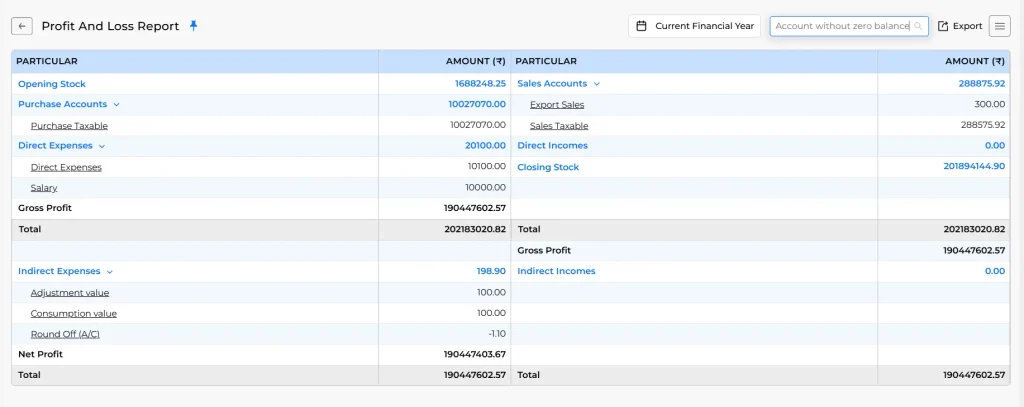
If you’re already using Munim, review your sales and purchase entries and use the Profit & Loss report to check business income and expenses before discussing tax figures with your CA.
Start your 7-day free trial and organise your business accounts from day one.
Common Questions About Proprietorship Firms
Can I register a proprietorship firm completely online?
Most major registrations such as GST and Udyam can be completed online. However, there is no single online portal that incorporates a proprietorship.
Can a proprietorship firm have two owners?
No. A sole proprietorship is owned by one individual. If two or more people will own the business, consider another structure such as a partnership, LLP or company.
Can I use a business name different from my personal name?
Yes. A proprietor can operate under a trade name. However, the legal identity remains connected with the proprietor.
Can I start a proprietorship without GST?
Yes, where GST registration is not otherwise required. GST applicability depends on turnover, activity, state and other registration provisions.
Which accounting software can a new proprietorship use for billing and GST from day one?
You can use Munim Billing & Accounting to create invoices, record purchases and expenses, manage stock and review financial reports. If GST registration applies to your business, you can maintain GST-related billing records as part of your accounting workflow.
Disclaimer: "This blog post is for informational purposes only. For specific tax advice related to your business, please consult a qualified Chartered Accountant or GST practitioner."
About the author

Mehul is a seasoned content writer with a passion for simplifying complex accounting and GST topics. With a keen interest in entrepreneurship and business management, he specializes in creating informative and engaging content for themunim.com. His goal is to help businesses understand and implement accounting and GST software solutions effectively. When he's not crafting content, Mehul enjoys exploring new places and spending time with his Golden Retriever.
Related Articles
Explore the latest market news, useful resources for business, and Munim updates.