
PIN to PIN Distance for E-Way Bill: Rules and Examples
 AuthorMehul Jagwani
 Reviewed ByCA Madhav Bhayani



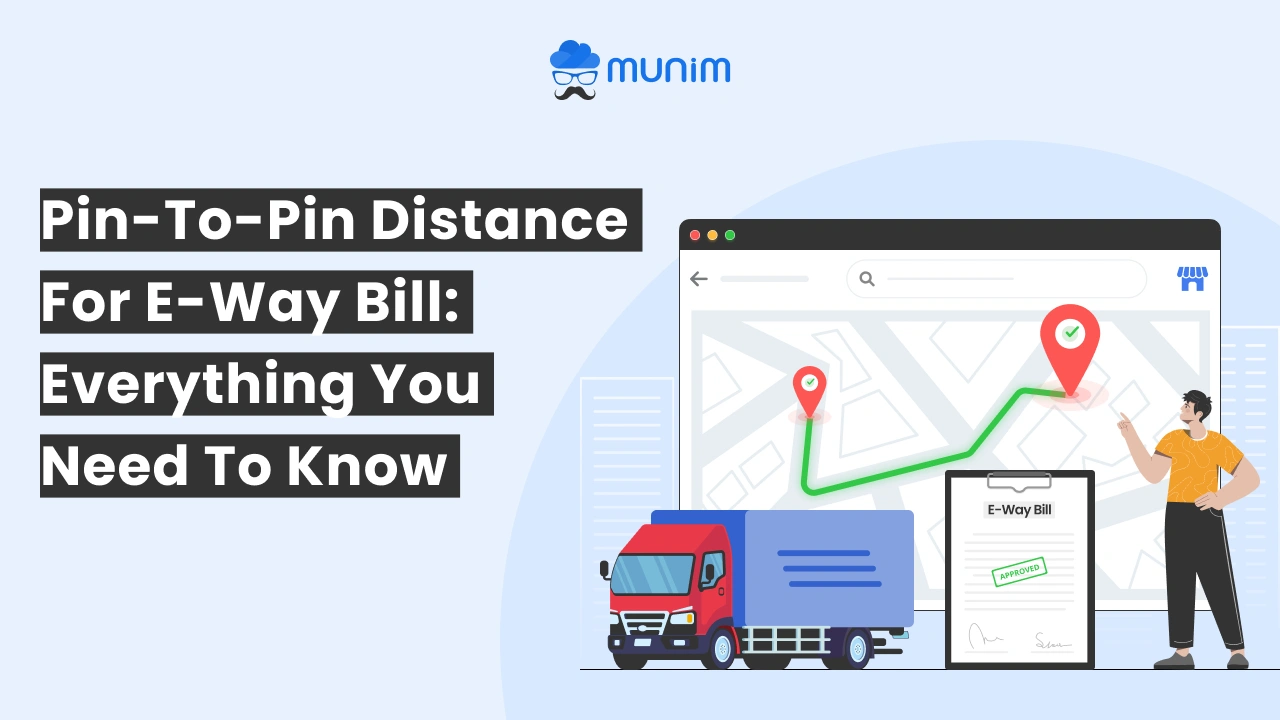
PIN-to-PIN distance is the estimated motorable distance between two locations identified by their six-digit postal PIN codes. Under the GST e-way bill system, the dispatch and delivery PIN codes are used to determine the approximate distance goods will travel.
For example, when you transport goods from Surat to Delhi, the system estimates the distance using the PIN codes of the dispatch and delivery locations.
However, PIN-to-PIN distance is not necessarily the exact distance between your warehouse and the customer’s address.
The actual distance may vary depending on:
- The specific pickup and delivery locations
- Available highways and roads
- Route restrictions
- Road closures and diversions
- Different routing databases
The government e-way bill portal uses its own distance database. Therefore, results from Google Maps or other distance calculators may differ.
Why Is PIN to PIN Distance Important for E-Way Bills?
Distance is important because it directly affects how long an e-way bill remains valid.
Here are four reasons why businesses should verify it before dispatching goods.
1. Determine E-Way Bill Validity
The transportation distance helps determine the validity period of an e-way bill.
For regular cargo, the standard validity is one day for up to 200 km. Every additional 200 km or part thereof adds another day.
2. Avoid Incorrect Transportation Details
Entering an incorrect dispatch or delivery PIN code can produce an inaccurate distance. This may cause problems when generating an e-way bill or verifying shipment information.
3. Plan Transportation
Knowing the approximate distance helps transporters plan routes and estimate delivery times. It also helps businesses coordinate dispatch schedules.
4. Reduce Compliance Issues
Correct transportation details reduce the possibility of avoidable discrepancies during verification. Under Rule 138 of the CGST Rules, an e-way bill is generally required for transportation involving consignments valued above ₹50,000, subject to specified conditions and exemptions. Certain movements may require an e-way bill even when the consignment value is below ₹50,000.
Designed for Modern Tax Professionals
A premium filing solution for CAs and tax consultants who need speed, scale, and operational clarity.
 Handle multiple clients with ease
- Reconcile and validate with confidence
- Overcome the limitations of the GST portal
 Handle multiple clients with ease
How Does the GST Portal Calculate PIN to PIN Distance?
According to the National Informatics Centre (NIC), the system uses road network information and routing attributes to estimate the distance.
The government has also updated the distance database for certain PIN-code combinations over time.
How to Check PIN to PIN Distance on the GST Portal
Follow these steps:
- Visit the official e-way bill portal.
- Open the Search menu.
- Select PIN to PIN Distance.
- Enter the dispatch PIN code and destination PIN code.
- Complete the CAPTCHA verification.
- Click Go to view the approximate distance.
The displayed distance can help you verify the transportation details before generating an e-way bill.
You can also use our PIN to PIN Distance Calculator to get a preliminary road-distance estimate.
Remember that the official GST portal’s validation requirements take precedence over estimates from third-party calculators.
What Is the 10% Distance Rule for E-Way Bills?
The GST e-way bill system generally allows users to enter an actual transportation distance up to 10% higher than its automatically calculated PIN-to-PIN distance.
Let’s understand this with an example.
Suppose the GST portal calculates the distance between two PIN codes as 500 km.
| Particulars | Distance |
| Distance calculated by GST portal | 500 km |
| Additional 10% tolerance | 50 km |
| Maximum distance under this tolerance | 550 km |
In this case, the portal generally permits a declared distance of up to 550 km.
However, the 10% tolerance does not mean that you should automatically increase the transportation distance.
You should enter the appropriate distance based on the actual movement of goods and the portal’s validation requirements.
What if Both Locations Have the Same PIN Code?
When the dispatch and delivery locations have the same PIN code, the e-way bill system generally allows a maximum distance of 100 km.
Certain transaction types, such as line sales, have different validation provisions.
NIC’s API documentation specifies that line sales can have an allowance of up to 300 km under the applicable conditions.
How Does PIN to PIN Distance Affect E-Way Bill Validity?
Under Rule 138 of the CGST Rules, e-way bill validity depends on the transportation distance and cargo category.
E-Way Bill Validity for Regular Cargo
For regular cargo, the validity period is calculated at one day for up to 200 km and one additional day for every subsequent 200 km or part thereof.
| Transportation Distance | E-Way Bill Validity |
| Up to 200 km | 1 day |
| 201–400 km | 2 days |
| 401–600 km | 3 days |
| 601–800 km | 4 days |
| 801–1,000 km | 5 days |
| 1,001–1,200 km | 6 days |
Example:
Suppose your business transports goods over a declared distance of 450 km.
- First 200 km: 1 day
- Next 200 km: 1 additional day
- Remaining 50 km: 1 additional day
Total distance-based validity: 3 days
E-Way Bill Validity for Over-Dimensional Cargo
Over-dimensional cargo (ODC) follows a different validity calculation.
For ODC, validity is generally calculated at one day for every 20 km or part thereof.
| Transportation Distance | ODC Validity |
| Up to 20 km | 1 day |
| 21–40 km | 2 days |
| 41–60 km | 3 days |
| 61–80 km | 4 days |
| 81–100 km | 5 days |
Certain multimodal shipments involving transportation by ship also follow the 20 km validity schedule.
These validity calculations are specified under Rule 138 of the CGST Rules.
cbic-gst.gov.in
The final validity date and time are determined by the e-way bill system. For road transportation, validity generally begins when the first vehicle details are entered in Part B.
Common PIN to PIN Distance Errors and How to Avoid Them
Before generating an e-way bill, we recommend checking these common issues.
| Common Error | What You Should Do |
| Incorrect dispatch PIN code | Verify the actual location from which goods are dispatched |
| Incorrect delivery PIN code | Match the PIN code with the delivery address |
| Different distance on Google Maps | Verify the official e-way bill portal’s estimate |
| Identical PIN codes for both locations | Review the applicable same-PIN-code rules |
| Unexpectedly high or low distance | Recheck the PIN codes and transportation route |
| E-way bill may expire before delivery | Check the permitted validity-extension process |
If the portal cannot determine the distance between two PIN codes, verify the locations and follow the applicable government instructions.
Frequently Asked Questions
1. How can I calculate PIN to PIN distance for an e-way bill?
Visit the official e-way bill portal, go to Search > PIN to PIN Distance, enter the dispatch and destination PIN codes, complete the CAPTCHA and check the estimated distance.
2. Can I enter a distance higher than the GST portal estimate?
The e-way bill portal generally permits a distance up to 10% higher than its PIN-based estimate, subject to applicable exceptions and validation rules.
3. What is the e-way bill validity for 500 km?
For regular cargo, a declared distance of 500 km provides three days of distance-based validity.
4. Is PIN to PIN distance the same as Google Maps distance?
Not necessarily. Both systems may use different road network data and location references, so the estimated distances can differ.
5. What happens if an e-way bill expires before delivery?
Where exceptional circumstances prevent timely delivery, the eligible transporter may request a validity extension within the permitted timeframe, subject to the portal’s conditions.
Disclaimer: "This blog post is for informational purposes only. For specific tax advice related to your business, please consult a qualified Chartered Accountant or GST practitioner."
About the author

Mehul is a seasoned content writer with a passion for simplifying complex accounting and GST topics. With a keen interest in entrepreneurship and business management, he specializes in creating informative and engaging content for themunim.com. His goal is to help businesses understand and implement accounting and GST software solutions effectively. When he's not crafting content, Mehul enjoys exploring new places and spending time with his Golden Retriever.
Post Tags
Related Articles
Explore the latest market news, useful resources for business, and Munim updates.