Income Tax Benefits for Electric Two-Wheeler Buyers in India (2026)
 AuthorMehul Jagwani
 Reviewed ByMadhav Bhayani



- What Is Section 80EEB and Who Can Claim It in 2026?
- Can You Claim Section 80EEB on a New Loan Taken in 2026?
- Who Still Gets Section 80EEB Benefits in FY 2026-27?
- The Big 2026 Change: Tax-Free EV Perquisite for Salaried Employees
- How GST Savings Factor Into the Total Cost of an Electric Two-Wheeler
- Old Tax Regime vs. New Tax Regime: Which Is Better for EV Buyers?
- How to Claim Section 80EEB While Filing ITR
- Final Notes
- Frequently Asked Questions
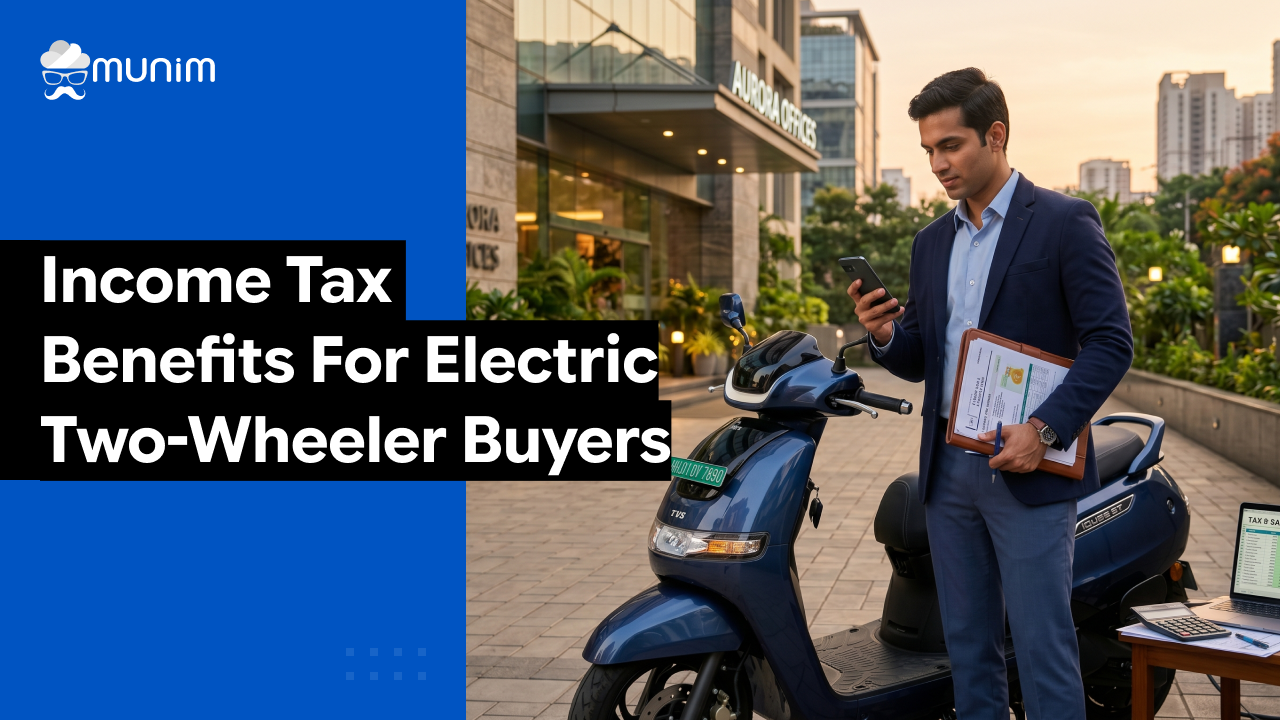
Electric two-wheelers are selling faster than ever in India. With over 60 lakh EV registrations projected for 2026 and brands like Ola Electric, Ather, TVS and Bajaj expanding their portfolios, the shift away from petrol scooters and motorcycles is well underway. But beyond fuel savings, the electric vehicle tax benefit available to Indian buyers remains one of the most underutilised financial advantages in the country’s tax structure today.
This guide breaks down what you can actually claim, what has changed from April 2026, and where the GST angle plays into your total cost savings.
What Is Section 80EEB and Who Can Claim It in 2026?
Section 80EEB of the Income Tax Act was introduced specifically to encourage electric vehicle adoption among individual taxpayers. It allows a deduction on the interest paid on a loan taken to purchase an electric vehicle, including two-wheelers.
The key condition: the loan must have been sanctioned between April 1, 2019, and March 31, 2023. If your loan falls within this window, you can continue claiming the deduction in Financial Year 2026-27 (Assessment Year 2027-28), as long as you file under the Old Tax Regime.
What does the deduction cover?
- Only the interest component of the loan is deductible
- The maximum deduction is Rs. 1,50,000 per financial year
- Only individual taxpayers can claim this (not partnership firms, companies, or HUFs)
- The deduction is not available under the New Tax Regime
It is worth clarifying a common misconception here. Section 80EEB (or 80 EEB, as it is commonly searched) is not a one-time deduction. You can claim it every year for the full loan tenure, so long as you are still paying interest and your loan was originally sanctioned within the eligible window.
Designed for Modern Tax Professionals
A premium filing solution for CAs and tax consultants who need speed, scale, and operational clarity.
 Handle multiple clients with ease
- Reconcile and validate with confidence
- Overcome the limitations of the GST portal
 Handle multiple clients with ease
Can You Claim Section 80EEB on a New Loan Taken in 2026?
No. This is a clean, firm answer that many buyers are not aware of.
If you take a fresh loan in 2026 to buy an electric two-wheeler, the Section 80EEB deduction is not available. The benefit window closed for new loan sanctions after March 31, 2023. Neither the Union Budget 2024-25 nor Budget 2025-26 extended this window.
Who Still Gets Section 80EEB Benefits in FY 2026-27?
If your electric two-wheeler loan was sanctioned between April 1, 2019, and March 31, 2023, you are still eligible to claim the deduction this year. Many buyers who purchased their vehicles during the post-pandemic EV adoption surge fall in this window.
Here is a quick eligibility check:
| Parameter | Condition |
| Loan Sanction Period | April 1, 2019 to March 31, 2023 |
| Vehicle Type | Electric two-wheeler (or four-wheeler) |
| Taxpayer Category | Individual only |
| 80EEB Deduction Limit | Up to Rs. 1,50,000 per year |
| What is Deductible | Interest paid on the loan (not principal) |
| Tax Regime | Old Tax Regime only |
| Assessment Year Applicable | From AY 2020-21 onwards |
If you have switched to the New Tax Regime, you will lose access to this deduction for that year. It can be worth doing a quick computation with your CA or using an online tax planning tool to see which regime saves you more overall.
The Big 2026 Change: Tax-Free EV Perquisite for Salaried Employees
This is the most significant new development for electric two-wheeler buyers in 2026, and it applies from April 1, 2026 onwards. In practical terms, it functions as an electric vehicle tax exemption on the higher perquisite values that petrol vehicles attract.
Under the new Income-tax Rules, 2026, the government has formally incorporated electric vehicles into the perquisite valuation framework. This matters enormously for salaried employees whose employers provide them with a vehicle or reimburse fuel and running costs.
Previously, there was ambiguity around how to value an employer-provided electric vehicle for tax purposes. That ambiguity is gone.
What Are the New Fixed Perquisite Values?
If the employer bears the running and maintenance costs:
- Rs. 5,000 per month is treated as a taxable perquisite
- An additional Rs. 3,000 per month applies if a chauffeur or driver is also provided
If the employee bears the running costs personally:
- Rs. 2,000 per month is the taxable perquisite value
- An additional Rs. 3,000 per month if a chauffeur is provided
How GST Savings Factor Into the Total Cost of an Electric Two-Wheeler
Income tax is only part of the picture. The GST structure for electric vehicles offers substantial savings at the point of purchase itself.
Electric two-wheelers attract GST at 5%, compared to 28% GST on petrol or diesel two-wheelers. EV chargers also fall under the 5% GST slab. This differential alone can reduce the upfront cost of an electric vehicle by a meaningful margin compared to a petrol equivalent of similar value.
Old Tax Regime vs. New Tax Regime: Which Is Better for EV Buyers?
This is a practical decision that every buyer still repaying an eligible EV loan from before April 2023 needs to make.
Under the New Tax Regime (which is now the default for most individual taxpayers), most deductions including Section 80EEB are not available. In exchange, the tax slabs are lower and the process is simpler.
Under the Old Tax Regime, you retain the ability to claim Section 80EEB along with other deductions like 80C, HRA, and home loan interest.
How to Claim Section 80EEB While Filing ITR
For taxpayers with eligible EV loans still active, here is a step-by-step overview of how to claim the deduction correctly:
- Obtain a loan interest certificate from your bank or NBFC for the relevant financial year
- Verify the loan sanction date is between April 1, 2019 and March 31, 2023
- Select the Old Tax Regime while filing your ITR (ITR-1 or ITR-2, as applicable)
- Claim the deduction under Chapter VI-A, specifically under Section 80EEB
- Keep the vehicle registration document and loan sanction letter handy for records
Final Notes
The income tax landscape for electric two-wheeler buyers in 2026 is a mix of legacy benefits and fresh incentives. The broader conversation around electric car tax benefits and two-wheeler tax deductions in India is still evolving, but the current framework already offers meaningful savings for those who know where to look. If you have an older EV loan from before April 2023, Section 80EEB is still worth claiming under the Old Tax Regime, saving up to Rs. 45,000 in tax annually at the 30% slab. For salaried employees, the new fixed perquisite valuation from April 2026 makes a company-provided electric two-wheeler far more tax-efficient than any petrol vehicle.
Frequently Asked Questions
1. Can I claim income tax benefit on buying an electric two-wheeler in 2026 with a new loan?
No. Section 80EEB deductions are only available for loans sanctioned between April 1, 2019 and March 31, 2023.
2. What is the maximum deduction allowed under Section 80EEB?
The maximum deduction allowed is Rs. 1,50,000 per financial year, applicable on the interest component of the loan.
3. Is Section 80EEB available in the New Tax Regime?
No. Section 80EEB is available only under the Old Tax Regime.
4. What is the GST rate on electric two-wheelers in India in 2026?
Electric two-wheelers attract GST at 5%. This is significantly lower than the 28% GST on petrol or diesel two-wheelers.
Disclaimer: "This blog post is for informational purposes only. For specific tax advice related to your business, please consult a qualified Chartered Accountant or GST practitioner."
About the author

Mehul is a seasoned content writer with a passion for simplifying complex accounting and GST topics. With a keen interest in entrepreneurship and business management, he specializes in creating informative and engaging content for themunim.com. His goal is to help businesses understand and implement accounting and GST software solutions effectively. When he's not crafting content, Mehul enjoys exploring new places and spending time with his Golden Retriever.
Related Articles
Explore the latest market news, useful resources for business, and Munim updates.