Sales Order vs. Purchase Order: Key Differences Explained
 AuthorJayant Surana
 Reviewed ByAjay Savani



Summary:
Navigating Sales Order vs. Purchase Order is essential. These vital procurement documents prevent costly operational mistakes while keeping your supply chain flowing smoothly. This complete guide explains their unique differences.
Every growing business relies on a smooth transaction process. Understanding sales order vs. purchase order is vital. Mistakes with procurement documents cause costly inventory nightmares quickly.
A smooth supply chain requires the proper documentation flow. These essential documents form a binding bridge between the two parties. They ensure everyone agrees before money or goods move.
What is a Purchase Order (PO)?
A purchase order is an official document from buyers. This important form tells the seller exactly what is needed. Once formally accepted, it becomes a legally binding commercial contract. For details, discover What is a purchase order? in our dedicated guide.
Careful buyers outline their exact needs to prevent costly errors. The buyer creates this form with these vital elements:
- PO Number: Both parties use this unique tracking number.
- Item Details: This section includes specific descriptions, quantities, and agreed prices.
- Delivery Date: This clearly shows exactly when goods should finally arrive.
- Terms: It outlines specific payment conditions and general shipping rules.
What is a Sales Order (SO)?
Sellers generate a sales order after approving a purchase. This vital document confirms the upcoming business transaction. It actively verifies stock levels and triggers the internal fulfilment. Explore: What is a sales order? thoroughly to master this critical document.
Organised sellers maintain total accuracy by checking their internal systems. The seller prepares this specific file containing these core details:
- SO Number: Inventory teams use this identifier to track daily progress.
- Billing Details: It clearly confirms the final invoiced financial amount.
- Shipping Info: This lists the specific delivery destination and precise tracking.
- Expected fulfilment: It officially commits to a specific outbound shipping date.
Sales Order vs. Purchase Order: The Key Differences
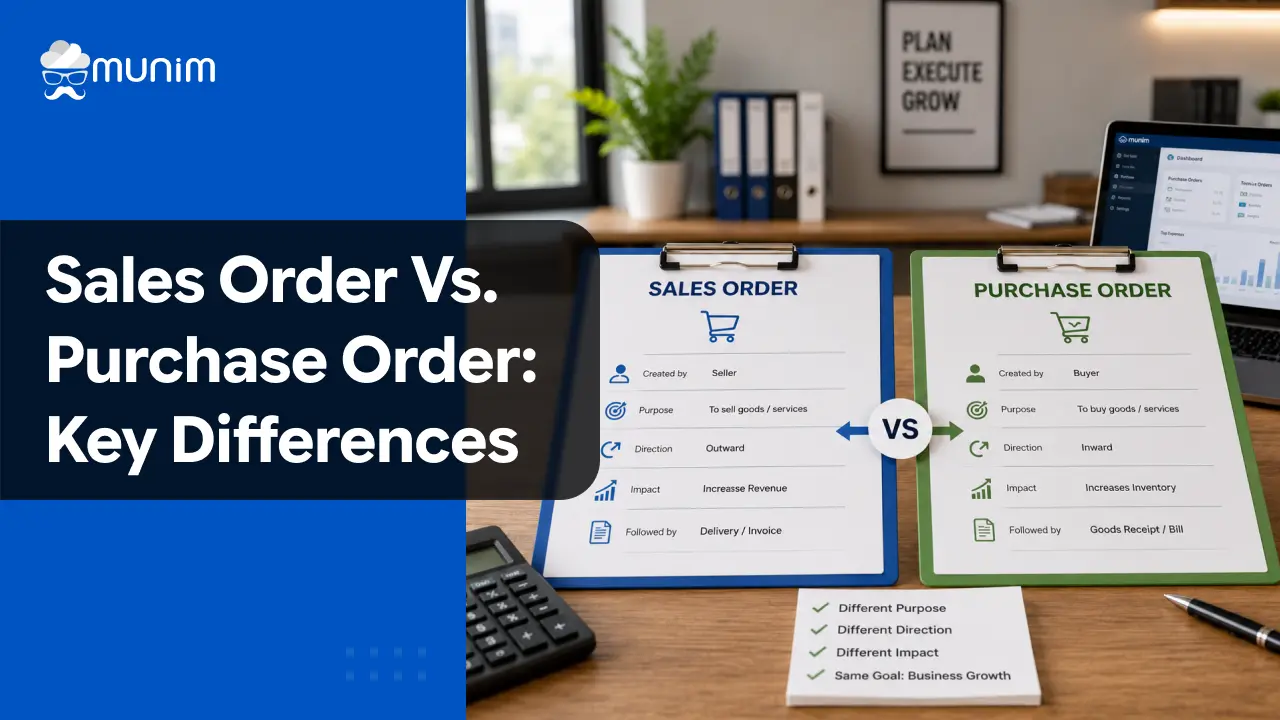
Comparing sales order vs. purchase order is straightforward. A purchase order is an official, formal request. Conversely, a sales order actively acts as the final confirmation.
The buyer asks to purchase items under strict conditions. The seller officially replies to accept the newly proposed transaction. Here is a clear functional comparison of the two documents:
| Feature | Purchase Order (PO) | Sales Order (SO) |
| Creator | The buyer formally creates this specific initial document. | The seller drafts this specific official confirmation record. |
| Recipient | The seller securely receives this specific initial request. | The buyer securely receives this final confirmation notice. |
| Purpose | It officially requests specific goods and authorises financial spending. | It officially confirms requested sales and triggers warehouse actions. |
| Timing | Prepared buyers send it early in the procurement process. | Approved sellers create it after accepting the initial request. |
| Finance | It represents future accounts payable leaving your bank accounts. | It represents future accounts receivable coming into your accounts. |
Simplify Your Business Operations
Designed to give you speed, control, and accuracy in daily accounting tasks.
 Save time with automated accounting workflows
- Get 35+ detailed business reports easily
- Access your business anytime, anywhere
 Save time with automated accounting workflows
The Order Lifecycle: How POs and SOs Work Together
Understanding the order lifecycle shows how these documents collaborate. Both forms connect your complex supply chain from the first request to the final delivery.
The Five-Step Lifecycle Process:
Step 1: Buyers identify their specific needs and immediately send a formal purchase order.
Step 2: The receiving seller reviews the submitted document for total accuracy.
Step 3: Sellers formally approve the request and quickly generate a sales order.
Step 4: This active sales order triggers the internal warehouse fulfilment process.
Step 5: On delivery, the invoice is matched against both the PO and SO (three-way matching).
Real-World Example: An Indian Textile Scenario
Understanding a sales order vs. a purchase order is very easy. Let us look at a practical Indian textile trader scenario.
A buyer explicitly orders 100 metres of premium fabric. They sent PO #1024 detailing the ₹250/metre price. This document includes expected delivery dates and standard GST details. The local seller reviews this specific incoming document carefully. They approve the request and promptly generate SO #SO-2207.
This officially confirms the upcoming fabric shipment for the buyer. Specific numbers keep local business records completely organised daily.
Document Distinctions: PO vs SO vs Invoice vs Quotation
Procurement involves several different business documents. Comparing sales order vs. purchase order helps. You must also understand quotations and final invoices.
- Quotation: Sellers send this preliminary price estimate out initially.
- Purchase Order: Buyers officially request specific goods using this form.
- Sales Order: Sellers formally confirm the transaction with this document.
- Invoice: Sellers finally demand actual payment using this record.
Quotations always happen before any formal orders begin. Invoices represent the final payment collection step.
The Power of Three-Way Matching
Three-way matching protects your company from fraud. This accounting process verifies three crucial procurement documents. It ensures you only pay for the received goods.
Accounts payable teams perform a strict three-way match. They compare the final invoice, purchase order, and GRN. This careful verification happens after the successful final delivery.
All three separate documents must match perfectly together. This prevents accidental overpayments and catches billing errors.
GST Compliance and E-Invoicing in India
Indian businesses must connect procurement documents with proper GST compliance. Your initial purchase orders help guide the final tax invoice. Accurate tracking ensures seamless business operations daily.
Generating compliant GST e-invoices strictly requires precise initial order data. Matching HSN codes across these specific documents is absolutely critical. This active alignment prevents frustrating monthly tax filing errors.
Best Practices for Managing Orders Efficiently
Efficient management prevents bottlenecks across your business. Proper document handling requires intelligent tools and clear internal team guidelines. Companies can improve daily operations by following proven industry methods.
- Buyers must verify strict budgets before issuing any new purchase orders.
- Smart sellers perform inventory checks to actively prevent embarrassing mistakes.
- Integrating robust accounting software automates your order workflows.
- Using powerful ERP systems reduces manual errors across your company.
- Buyers should implement effective purchase returns strategies for rejected goods.
- Sellers must properly track sales returns in accounting to maintain accurate books.
Streamline Documents With the Munim App
Creating these crucial business documents takes valuable time. The Munim app simplifies this manual process. Users access professionally designed templates within the app.
You can generate customised procurement documents. The Munim app automates your complicated tracking workflows. This keeps your business organised and efficient.
Stop wasting time drafting manual forms from scratch. Download the Munim app to streamline operations today.
Conclusion & Next Steps
Sales Order vs. Purchase Order analysis reveals distinct phases. Eager buyers initiate the transaction while organised sellers finalise the operational fulfilment process. Mastering these vital documents ensures financial accuracy.
Are you ready to optimise your business workflows today? Download free purchase order format and sale order formats by Munim and upgrade your internal systems.
Frequently Asked Questions (FAQs)
Is a purchase order legally binding in India?
Yes, a purchase order becomes a legally binding commercial contract. Under Indian contract law, the seller must officially accept it. Once formally accepted, both parties must fulfil their stated obligations.
What is the difference between purchase orders and sales orders?
A purchase order is an official request sent by a buyer. Conversely, a sales order is a confirmation created by the seller. The PO initiates the purchase, while the SO officially confirms fulfilment.
Which comes first: sales order or purchase order?
The purchase order always comes first in the transaction process. The buyer must initially request specific goods using a formal PO. Afterwards, the seller accepts it and formally issues the corresponding SO.
What are the 4 types of PO?
Businesses typically use four distinct types of purchase orders. These include standard, planned, blanket, and contract purchase orders. Each specific type serves uniquely different long-term or short-term procurement needs.
Which is first, PR or PO?
A purchase requisition (PR) always precedes a purchase order. Employees use a PR to internally request permission to buy items. Once management officially approves the PR, the purchasing department creates the PO.
Is a sales order proof of purchase?
No, a sales order is never official proof of purchase. It merely confirms that the seller intends to fulfil a request. A paid invoice or a final receipt serves as actual payment proof.
Can a PO and an SO have different tracking numbers?
Yes, they almost always feature different tracking numbers. The buyer’s accounting system generates the unique PO number. Meanwhile, the seller’s internal inventory software automatically assigns the SO number.
Disclaimer: "This blog post is for informational purposes only. For specific tax advice related to your business, please consult a qualified Chartered Accountant or GST practitioner."
About the author

Jayant is a senior content writer and digital marketer, known for his extensive experience in commercial SEO writing, blog content, website copy, and B2B communication. Since 2019, he has worked on diverse freelance projects across industries. His portfolio includes articles, landing pages, social media content, and web development collaborations. Blending clarity, creativity, and strategic messaging, he specialises in crafting professional, audience-focused content for themunim.com.
Related Articles
Explore the latest market news, useful resources for business, and Munim updates.